In 2026, artificial intelligence is becoming more than just a technology trend. It is now an integral part of users’ digital behavior.
AI assistants help people search for information, compare products, choose apps, and make purchasing decisions. At the same time, brands are exploring advertising within AI platforms, adding intelligent features to their products, and adapting their marketing strategies to new audience interaction scenarios.
This article is based on data from Sensor Tower’s State of AI 2026 Report.
We examine:
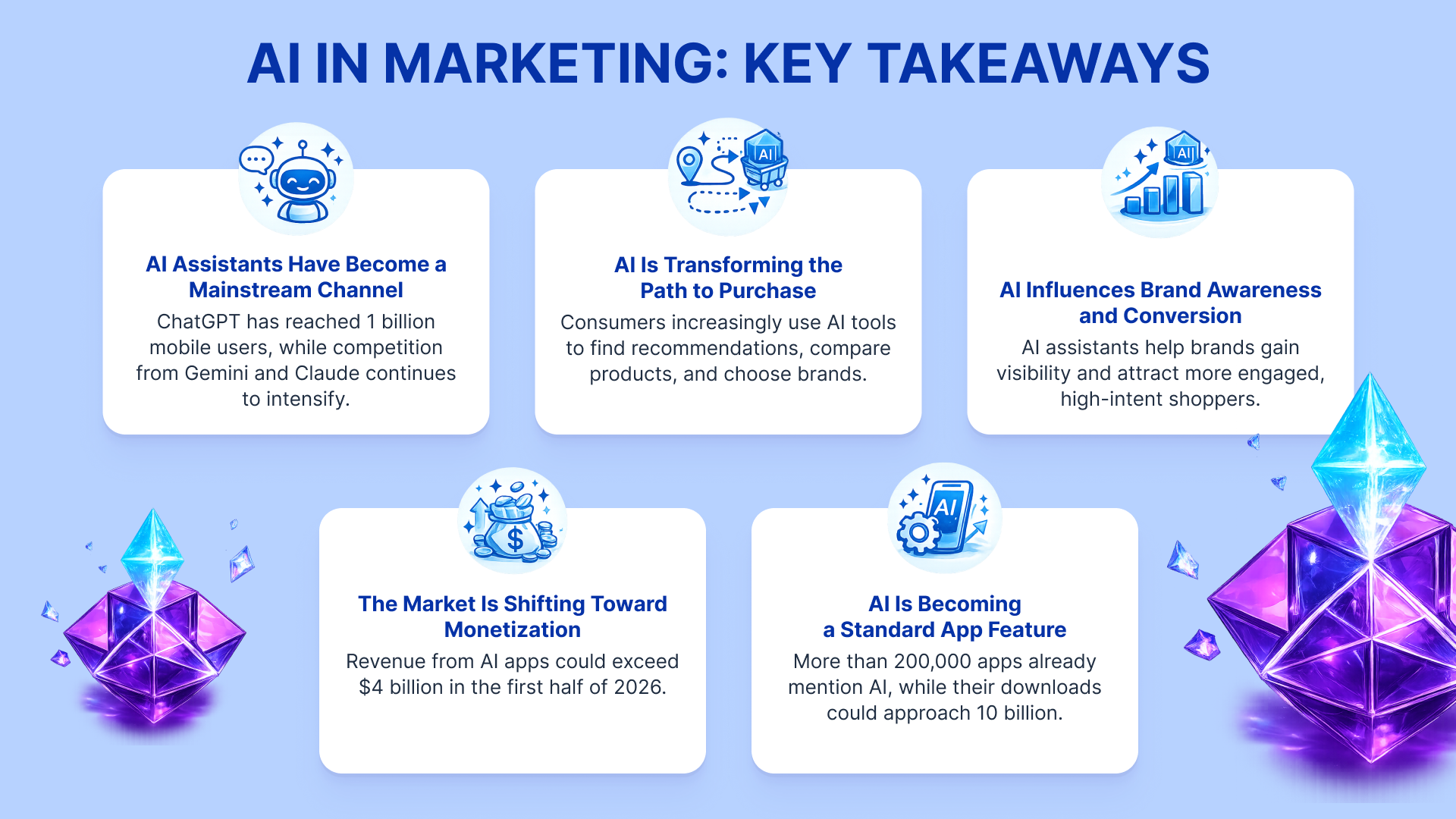
In May 2026, ChatGPT surpassed 1 billion monthly active mobile users, just three years after its launch. No other app, including TikTok, has ever reached this scale so quickly.
This shows that AI assistants have rapidly evolved from niche tools into mainstream digital products. They are now used by people across different age groups and regions.
ChatGPT continues to have the largest audience among the leading AI services. However, its advantage is gradually narrowing. Google Gemini is steadily expanding its user base through integration with Android and the wider Google ecosystem. Claude has demonstrated particularly strong growth since the beginning of 2026.
This suggests that the AI assistant market remains highly dynamic and that even the leadership of the largest platforms cannot be taken for granted.
Users are willing to switch services depending on their functionality, the reputation of the company, and its corporate decisions. For example, the number of ChatGPT deletions in the United States increased sharply after OpenAI signed an agreement with the US Department of War.
Traffic from generative AI services to online retail websites is growing across all major retail categories.
Between Q4 2024 and Q1 2026, the most significant growth was recorded in computers and consumer electronics. The share of visits originating from AI services increased almost fourfold, from 0.2% to 0.8%.
AI assistants are especially popular in categories where customers need to study product specifications, compare several options, and gather additional information before making a decision.
By Q1 2026, the share of traffic from generative AI sources exceeded 0.35% in electronics, home and garden products, and sports and outdoor goods.
This indicates that AI is gradually becoming an important part of the customer journey. Users turn to assistants for recommendations, compare products, and clarify specifications before visiting a retailer’s website.
For brands, this creates a new opportunity to establish a presence during the product research and consideration stages.
Although generative AI services currently account for less than 1% of overall web traffic, their influence extends beyond direct website visits.
AI assistants are increasingly involved in information searches, shaping perceptions of brands, and helping users make future purchasing decisions.
This role is particularly visible in the computers and consumer electronics category. Leading brands receive a high share of mentions in AI-generated responses, making them more visible during the product research and comparison stage.
The share of visits to these brands’ websites also remains relatively high, although it is lower than their share of mentions. This suggests that AI primarily helps users explore the market, while the visit to a retailer’s website takes place later.
A different pattern is emerging in the home and garden category. Here, a high share of website visits is combined with a lower share of brand mentions in AI responses.
AI assistants may be more likely to direct users straight to a website in this category once their preferences have already been partially formed and they are closer to taking a target action.
Therefore, the influence of AI depends on the product category. In some cases, assistants primarily serve as a tool for increasing awareness and introducing users to a brand. In others, they become a source of traffic at later stages of the marketing funnel.
Amazon shoppers who use the Rufus AI assistant are almost twice as likely to complete their session with a purchase.
In Q1 2026, the conversion rate among Rufus users exceeded 40%, compared with approximately 20% among other Amazon visitors.
This difference may be explained by the assistant’s ability to help users find relevant information, compare products, and resolve concerns before placing an order.
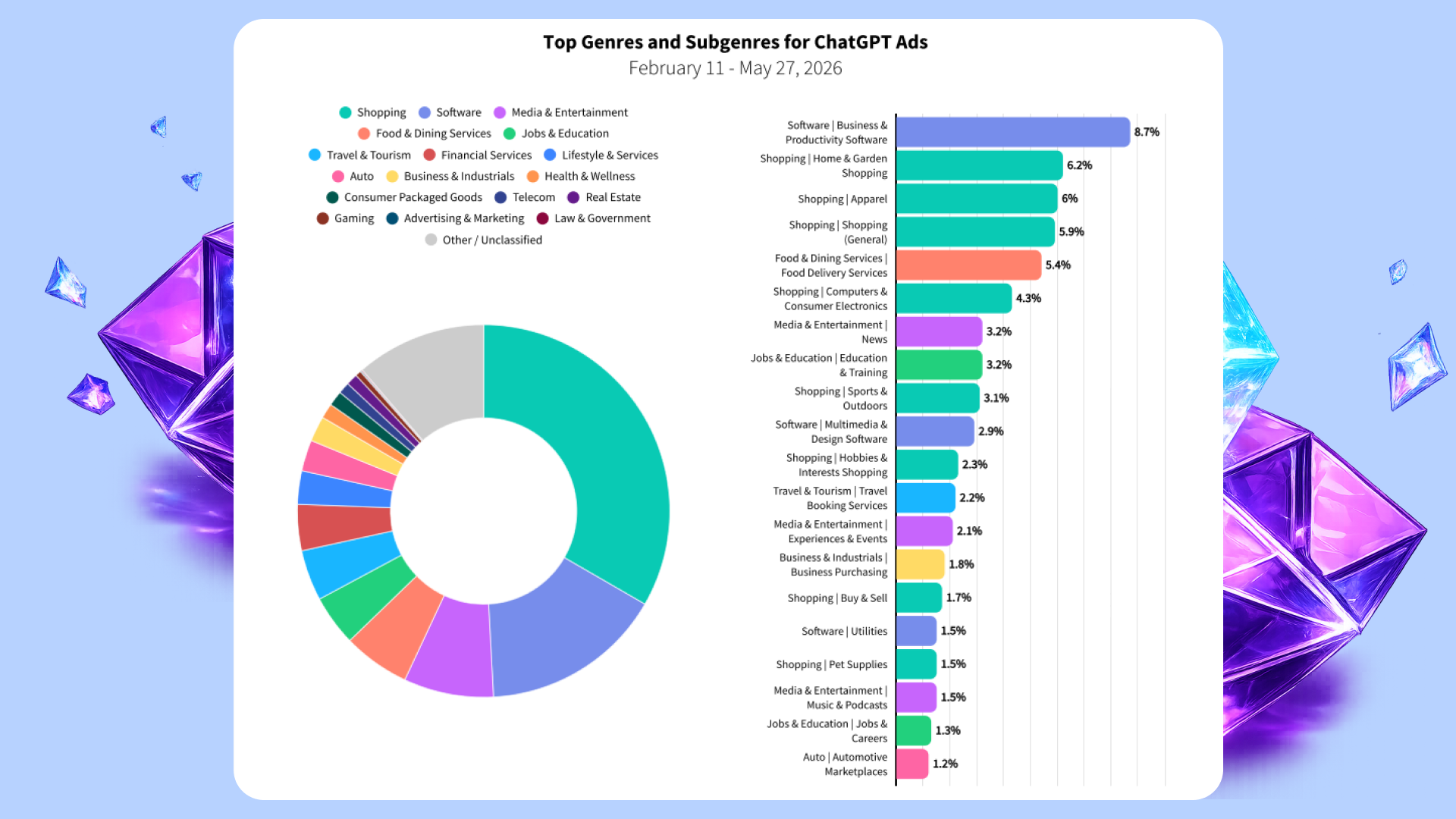
Brands in the Shopping and Software categories were among the first to start advertising in ChatGPT. Together, they account for almost half of all advertising placements on the platform.
In addition to retail and software, other prominent advertising categories include:
However, advertising financial products in ChatGPT is available only to partners approved by the platform.
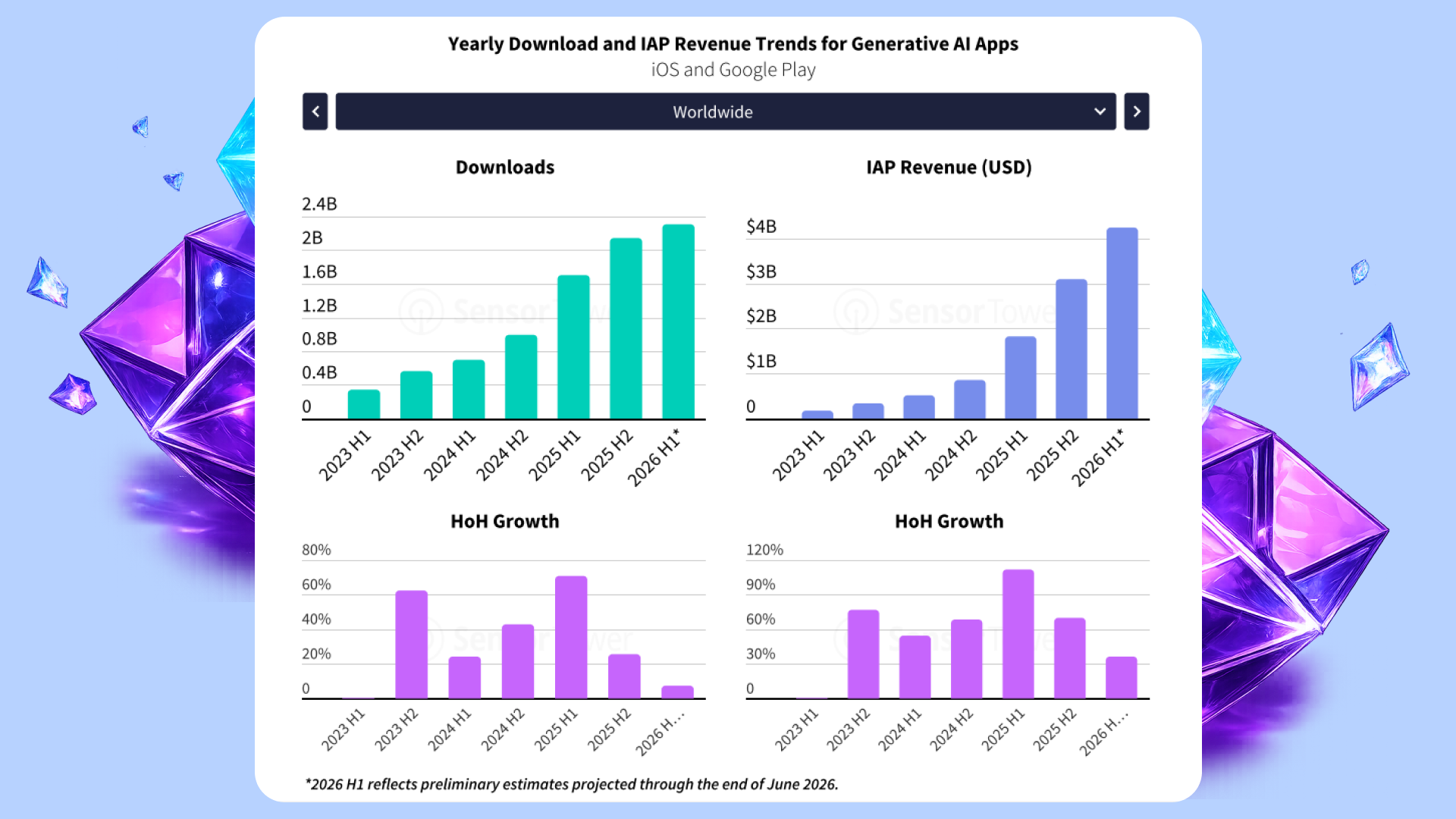
The generative AI app market continued to expand in the first half of 2026, although download growth became more moderate.
According to Sensor Tower’s forecast, global downloads will reach 2.3 billion, which is 7% higher than in the second half of 2025.
For comparison, downloads increased by 71% in the first half of 2025 and by a further 26% in the second half of the year.
The slowdown indicates that the market is gradually maturing after a period of widespread AI service launches and the integration of artificial intelligence into products developed by the world’s largest technology companies.
At the same time, category revenue continues to grow much faster than the audience.
In the first half of 2026, global revenue from in-app purchases in AI applications is expected to increase by 36% compared with the previous six-month period and exceed $4 billion.
This growth is being driven by more than ChatGPT alone. Claude, Grok, and other AI services are actively developing paid subscriptions and additional features, expanding monetization opportunities across the entire category.
In Q1 2026, generative AI websites received more than 67 billion visits. The total amount of time users spent on these platforms approached 23 billion hours.
Despite the slowdown that followed the rapid growth recorded in 2025, the overall trend remained positive.
Generative AI is gradually evolving from a tool used for occasional queries into a regular part of digital behavior.
India remains the largest market for generative AI web services. In Q1 2026, the country accounted for more than 13 billion visits.
The United States ranked second, with more than 8 billion visits.
Strong growth rates were also recorded in Argentina, South Korea, Turkey, Japan, and Vietnam. AI adoption is advancing simultaneously in developed countries and rapidly growing digital markets.
For global brands, this means that the audience of AI services is becoming increasingly geographically diverse. Communication strategies therefore need to be adapted to regional characteristics and different usage scenarios.
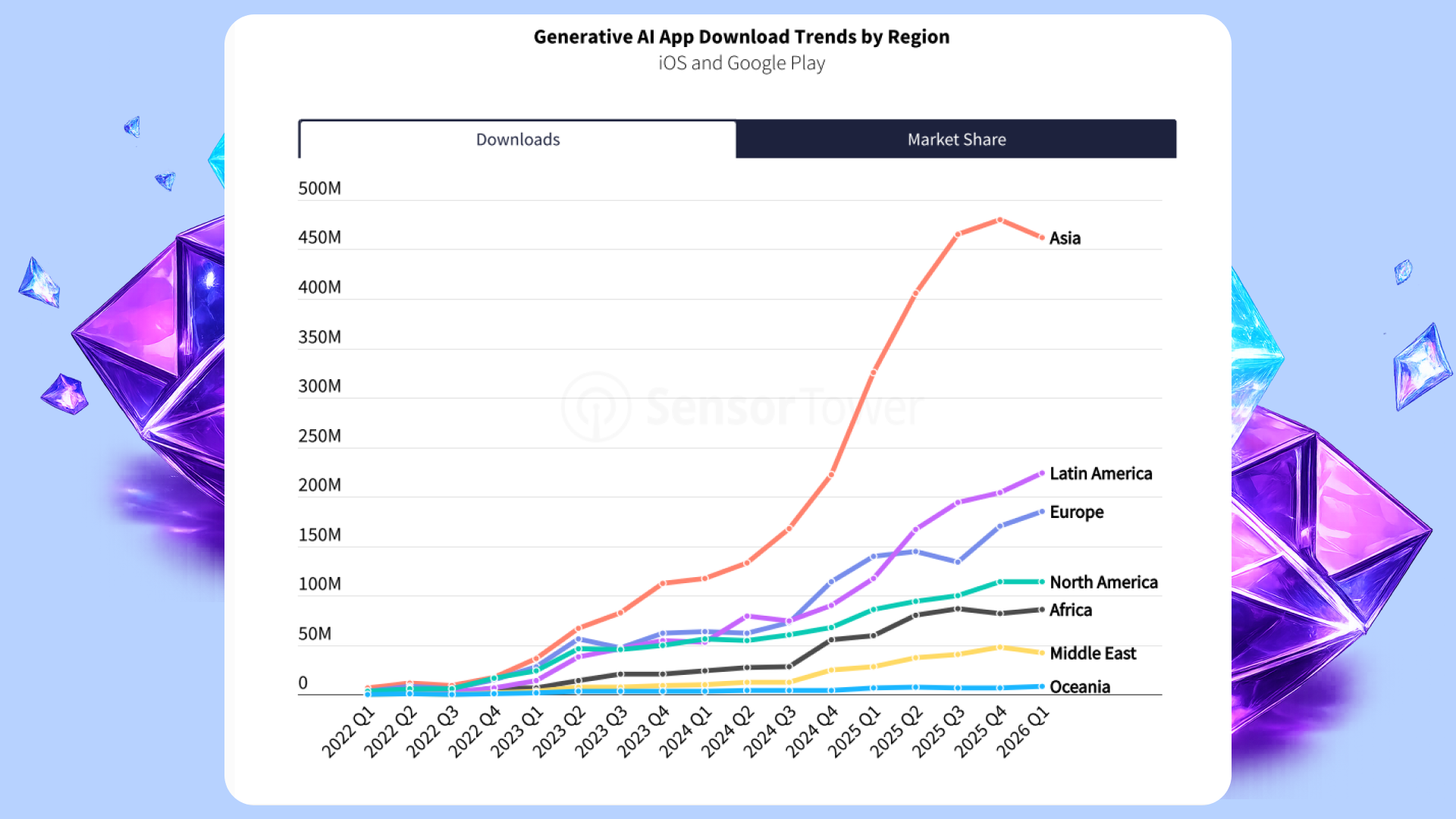
Asia remains the largest region, with approximately 450 million downloads per quarter. However, the market is gradually approaching stabilization.
Latin America has already exceeded 200 million downloads, while Europe has approached 170 million.
North America continues to grow and ranks fourth, with approximately 100 million downloads. However, its share of the global total is declining because other regions are developing faster.
India and China have already passed their peak download levels, while Brazil has become one of the category’s main growth drivers.
Brazil has overtaken China and moved into third place globally by the number of AI app downloads.
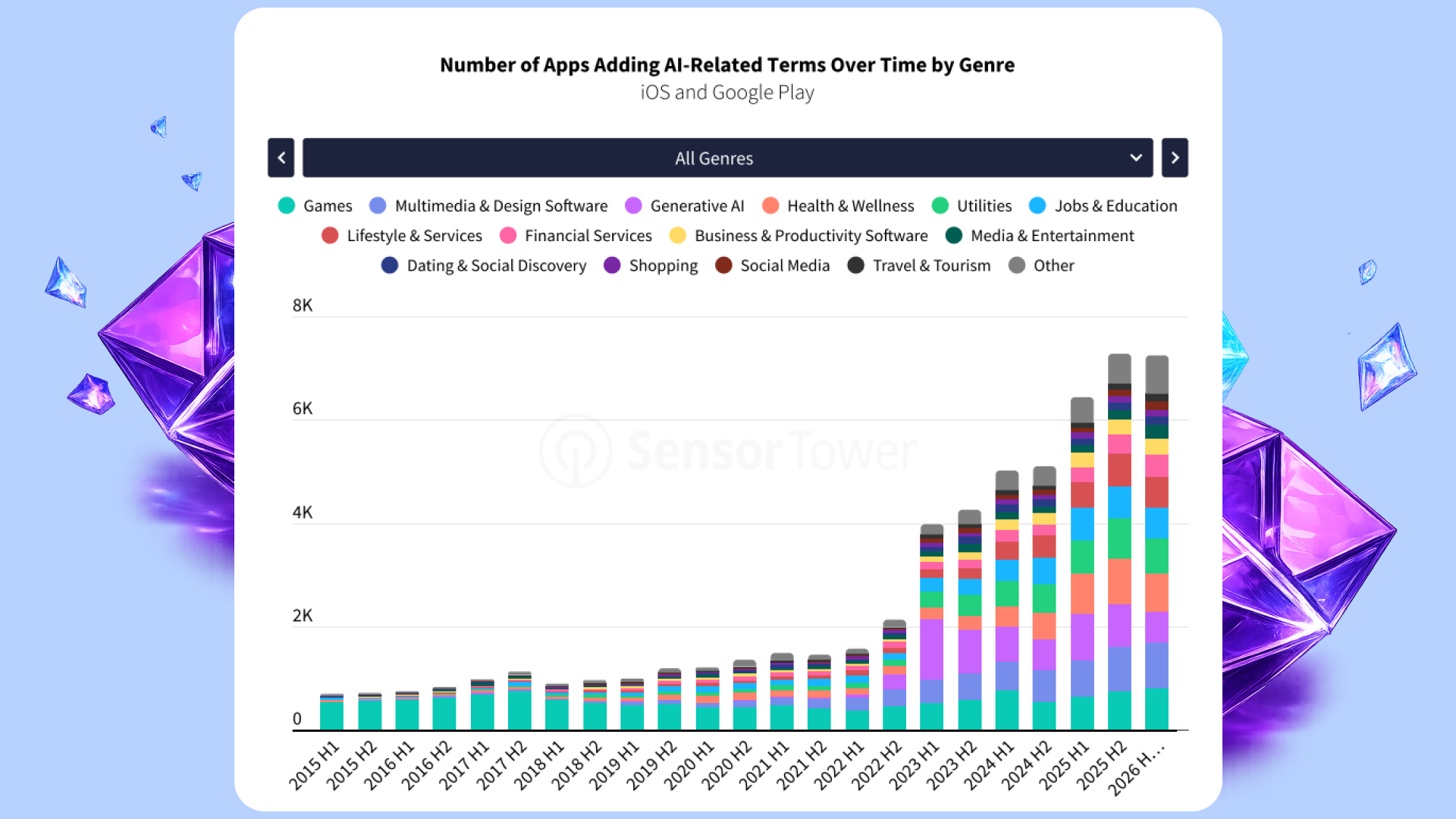
Artificial intelligence is increasingly becoming an integrated feature of products that were not originally classified as generative AI applications.
More than 200,000 apps in the iOS App Store and Google Play now mention AI in their descriptions.
Developers use both general phrases, such as “AI-powered” and “AI technology,” and more specific feature descriptions, including “AI tutor,” “AI music,” “AI investing,” and “AI opponents.”
In the first half of 2026, downloads of apps mentioning AI could approach 10 billion.
This figure increased by 25% year over year and by 173% compared with the first half of 2023.
Demand is growing particularly quickly in categories that began adopting AI later. Downloads in jobs and education, health, financial services, shopping, lifestyle, and services increased by more than 40% year over year.
This suggests that users are beginning to perceive AI not as a standalone product, but as a useful feature within the apps they already use.
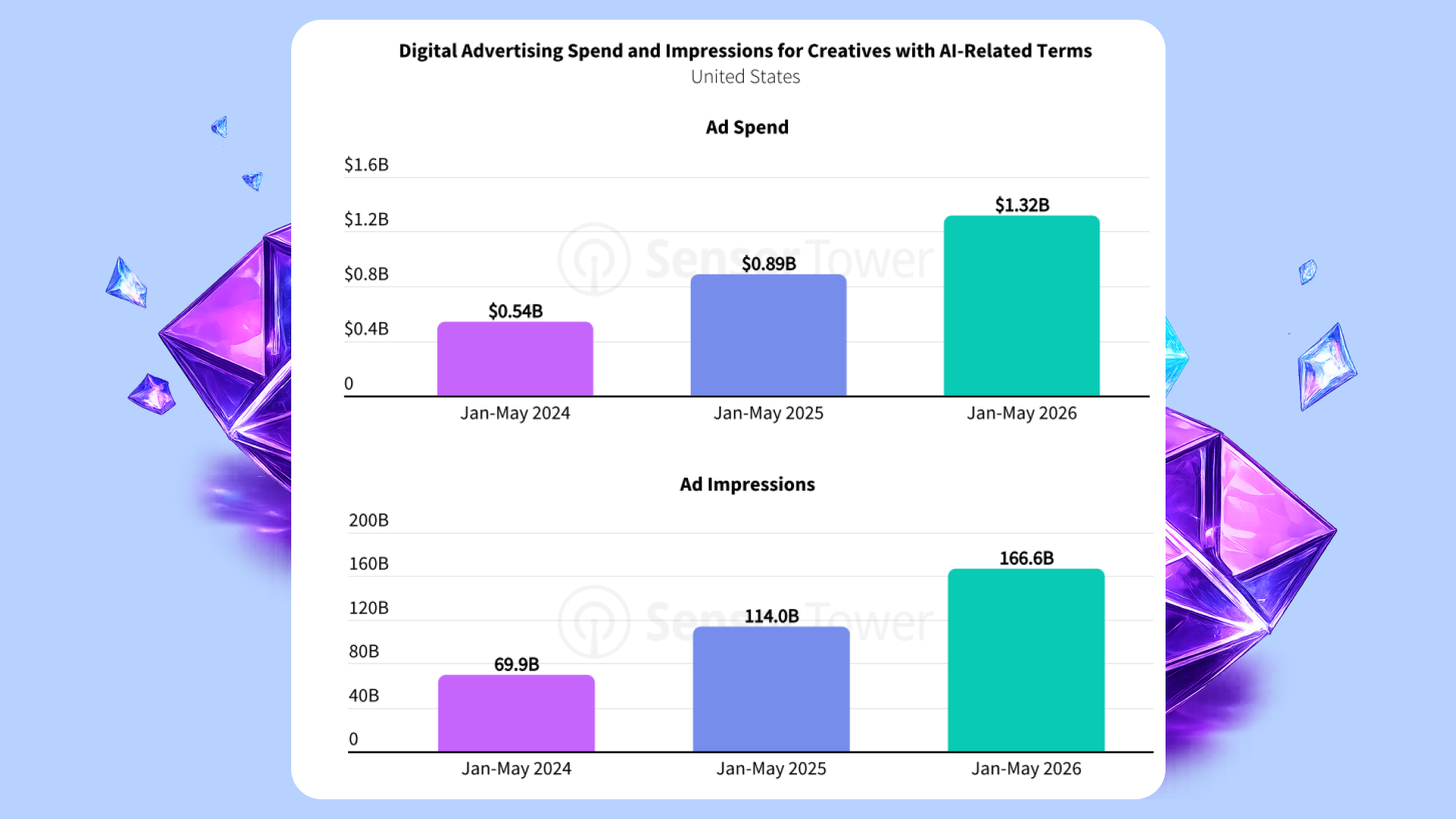
AI is changing not only promotional tools, but also the customer journey itself.
Information searches, initial exposure to brands, offer comparisons, and purchasing decisions are increasingly taking place within AI services or with their assistance.
This creates several priority areas for brands:
Brands that take these changes into account can engage with audiences earlier in the customer journey and have a greater influence on their decisions.
The BYYD platform uses artificial intelligence and machine learning for precise targeting, anonymized data analysis, and the optimization of mobile advertising campaigns.
AI is also used in BYYD’s proprietary anti-fraud system, which identifies invalid traffic and helps improve the overall quality of advertising placements.
For over 11 years, the BYYD team has been working with mobile advertising and creating banners designed for real user engagement. We help brands capture audience attention and achieve business objectives through proven mechanics.
Check out our case studies and send us an email – let’s launch your next campaign together.
Found this helpful? Share it with your friends and colleagues!
For consultations and partnership inquiries:


