Mobile App Trends 2026: Adjust Report on Growth, User Behavior, and New Technologies
In 2025, users around the world downloaded more than 112.1 billion apps. And this is only one part of a much bigger picture. According to forecasts, the global mobile app market will exceed $1.23 trillion by 2035. Mobile technologies and services are also expected to account for 8.4% of global GDP by 2030.
Against this background, 2025 became a year of active experimentation. The market tested AI tools, new approaches to automation, and more flexible solutions for mobile marketing. But the faster the industry develops, the more important reliable data becomes. Not abstract forecasts, but practical analytics that can help brands plan campaigns and grow in 2026.
Based on Adjust’s Mobile App Trends 2026 Edition report, we look at:
- How mobile marketing is changing.
- What is happening with user behavior.
- Why advertising in mobile apps is becoming an increasingly important tool for brand promotion.
Mobile App Installs Worldwide Grew by 10% Year-on-Year
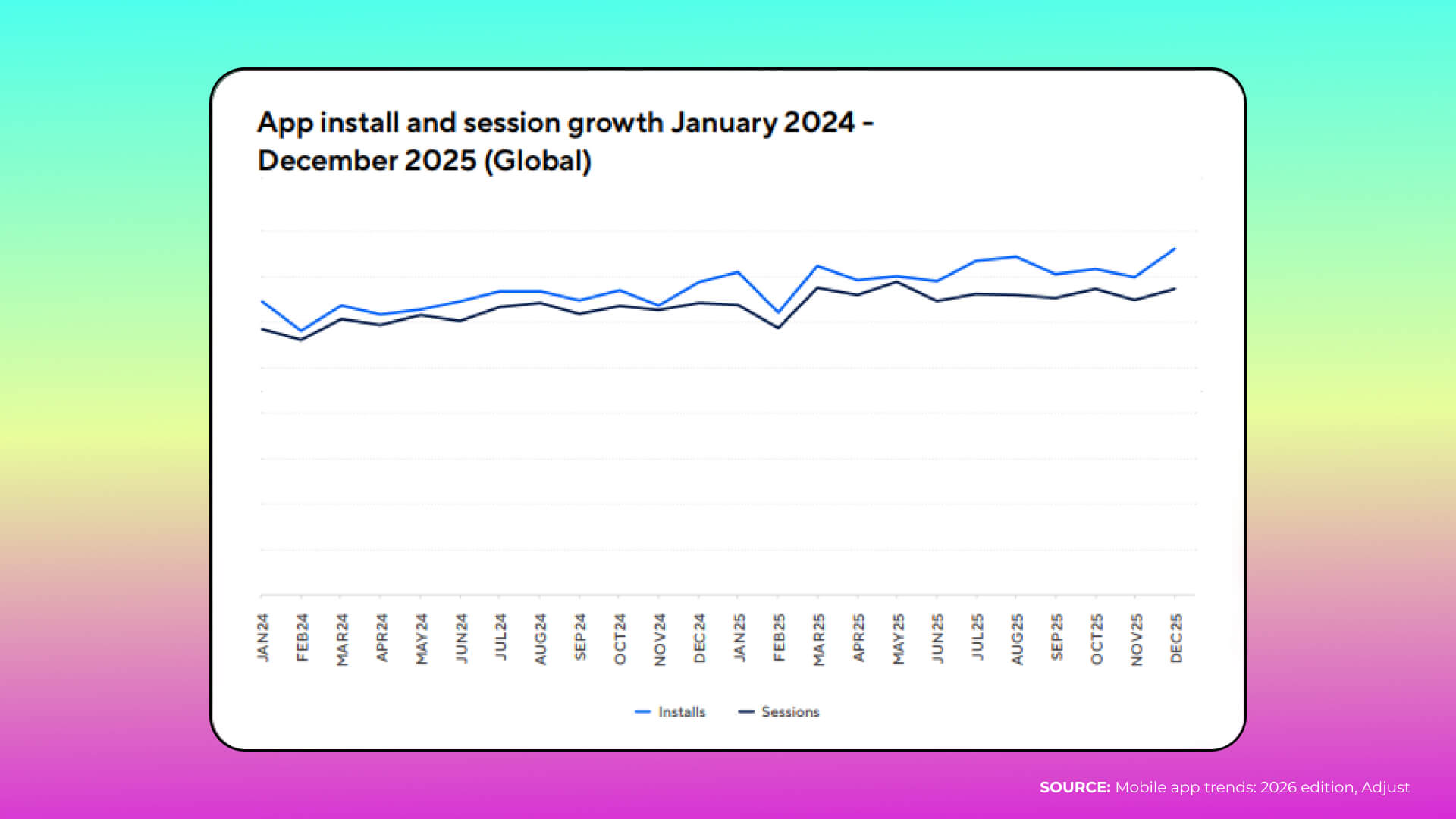
In 2025, the mobile market continued to grow. App installs increased by 10% year-on-year, while sessions grew by 7%.
However, growth was uneven throughout the year. In February, the market reached its lowest point. App installs were 13% below the annual average. After that, the market began to recover. By December, installs were already 8% above the average level. Sessions followed a similar trend and ended the year 3% above the baseline.
This shows that mobile continues to play a stronger role in users’ everyday lives. Apps remain a key channel for interacting with businesses, e-commerce, financial services, and entertainment. Mobile apps are becoming a full-fledged environment for building communication with audiences.
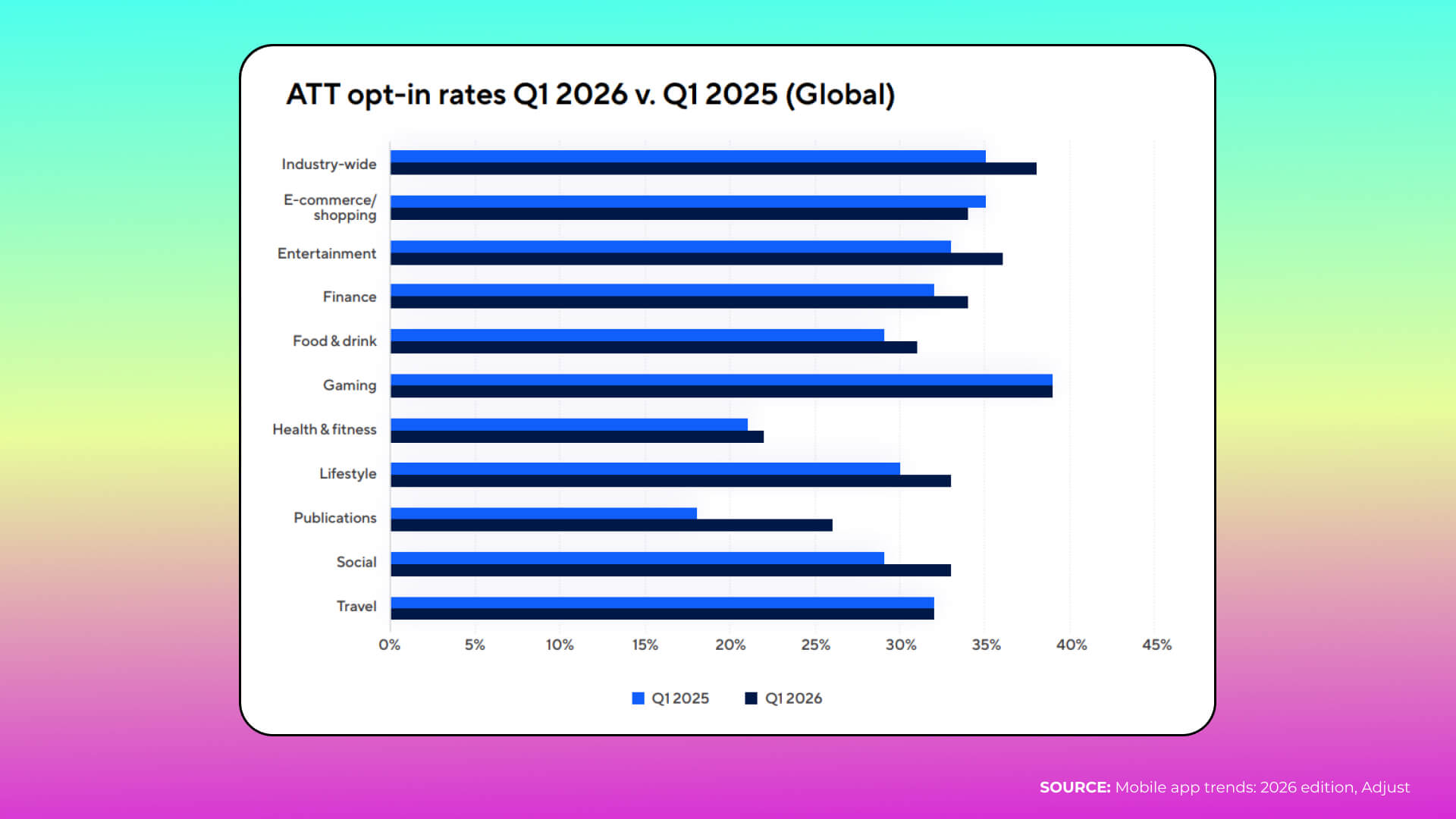
In the first quarter of 2026, Apple device users became more likely to allow app tracking. The average market rate increased from 35% to 38% over the year.
The highest consent rate remains in the gaming category. Here, 39% of users allowed tracking. Entertainment, finance, lifestyle, and social apps also showed growth.
At the same time, shopping apps saw a slight decline in tracking consent — from 35% to 34%.
This means that users are ready to share data when they understand why it is needed. That is why a tracking request should not be just a formal system pop-up. It should be part of clear communication with the user.
For example, in financial services, it is important to focus on transparency. Brands should explain what data is used and how it helps improve the user experience. The clearer the value is for the user, the higher the chance of consent.
How AI Is Changing Mobile Marketing in 2026
In 2026, AI is fully moving from experimentation to practical use. For marketers, it is becoming a way to work with data faster, understand audiences more accurately, and test hypotheses more effectively.
Data Analysis Assistants
Marketers work with large volumes of information every day. This includes campaign reports, data from advertising platforms, analytics systems, CRM platforms, and other sources. The more channels there are, the harder it becomes to quickly identify what matters most.
AI assistants help simplify this process. Instead of manually comparing spreadsheets and searching for insights across dozens of tabs, marketers can ask an AI tool questions in natural language and receive answers in real time.
As a result, these tools help teams find the right metrics faster, build custom reports, and share results with colleagues. Less time is spent on routine tasks, and more time is left for decision-making and optimization.
Smart Audience Segmentation
In the past, segmentation was often based on broad and static attributes: age, gender, geography, or basic interests. These segments were created manually and did not always keep up with changes in user behavior.
Today, the approach is becoming more flexible. Marketers use first-party data and machine learning to group users not only by demographics, but also by their actions.
These segments can be updated automatically. If a user’s behavior changes, the system takes this into account and adjusts their audience segment. This makes communication more accurate and ad campaigns more relevant across different channels.
Generative AI Moves Toward Practical Use
Generative AI is no longer evaluated only by how many texts, images, or ideas it can create. The key question now is what business result it can deliver.
Teams use generative AI to test creatives, adapt messages for different audiences, and improve in-app communication. This helps them test hypotheses faster and identify formats that actually work.
At the same time, adoption levels still vary. Many companies are still at an early stage of using generative AI. However, those that have already built a systematic approach report efficiency gains of more than 20%.
This shows an important shift. In 2026, the advantage belongs not to those who simply test AI, but to those who know how to integrate it into their processes.

Anastasia Zayarnyuk, Head of Internet Marketing at BYYD:
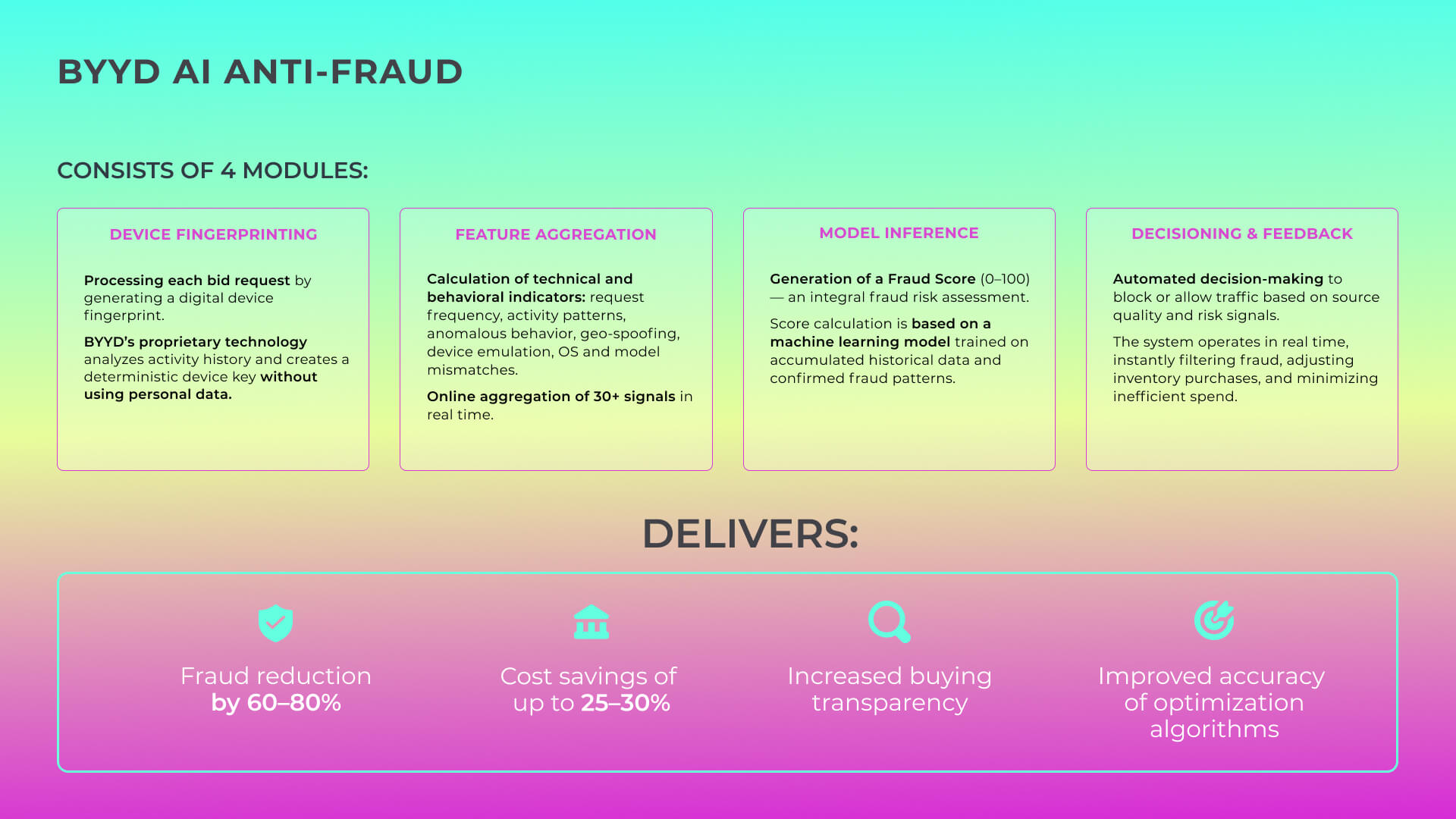
At BYYD, we use AI as a tool that strengthens every stage of working with advertising campaigns — from creative development and video production to anti-fraud, traffic quality control, optimization, and the development of AI-powered targeting. When it comes to trust in AI-managed campaigns, yes, we trust them, but only together with expert oversight. AI is excellent at scaling, bid optimization, and budget allocation. But strategy, hypothesis selection, data interpretation, and final decisions still remain with people.
How Cross-Channel Analytics Helps Reveal the Real User Journey
Businesses often build their marketing around mobile devices. In 2026, this approach is becoming broader. The focus is shifting toward a unified user experience across all platforms.
Users rarely move toward a purchase in a straight line. They may read information in a mobile browser, then compare options on a desktop, and complete the purchase inside an app.
Because of this, blind spots appear in analytics. Some user actions are lost between devices, channels, and platforms. As a result, the user journey looks shorter than it really is.
Data protection restrictions make the picture even more complex. Marketers find it harder to assess the contribution of each channel. Because of this, budgets may be allocated away from the channels that actually create value.
This problem is already visible in the market. Only around 31% of specialists are fully satisfied with how data from different platforms is unified.
Cross-channel measurement helps close these gaps. It connects user actions across different devices and channels. For example, it can show the journey from a mobile browser to an in-app action, or from an email newsletter to an app install.
This approach shows the real role of each channel. Channels no longer compete for the last touchpoint. Instead, marketers can see how they work together to drive results.
The Mobile Gaming App Market in 2026
Mobile games remain one of the strongest segments of the app market. In 2025, eight out of the ten most popular mobile games generated more than $1 billion from player spending.
The audience also continues to grow. There are almost 3 billion mobile gamers worldwide. This is more than 80% of the global gaming audience. Such scale makes mobile gaming an important environment not only for developers, but also for brands that want to reach engaged users.
At the same time, regional dynamics differ. In the Middle East and North Africa, the market showed growth. Installs increased by 2%, while sessions grew by 7% year-on-year.
In Europe and Latin America, installs declined by 7% and 9%, respectively. But this does not mean that interest in mobile games is falling. In Europe, sessions grew by 3%. In Latin America, sessions remained almost stable. Users are installing new games less often, but they continue to actively return to the apps they have already chosen.
In the Asia-Pacific region, both indicators declined slightly. North America also showed negative dynamics: installs fell by 5%, while sessions decreased by 2%.
Overall, the data shows that the mobile gaming market is becoming more mature. Growth is no longer always measured by new installs. The following factors are becoming more important:
- Retention.
- Quality of the user experience.
- The ability of apps to bring users back again and again.
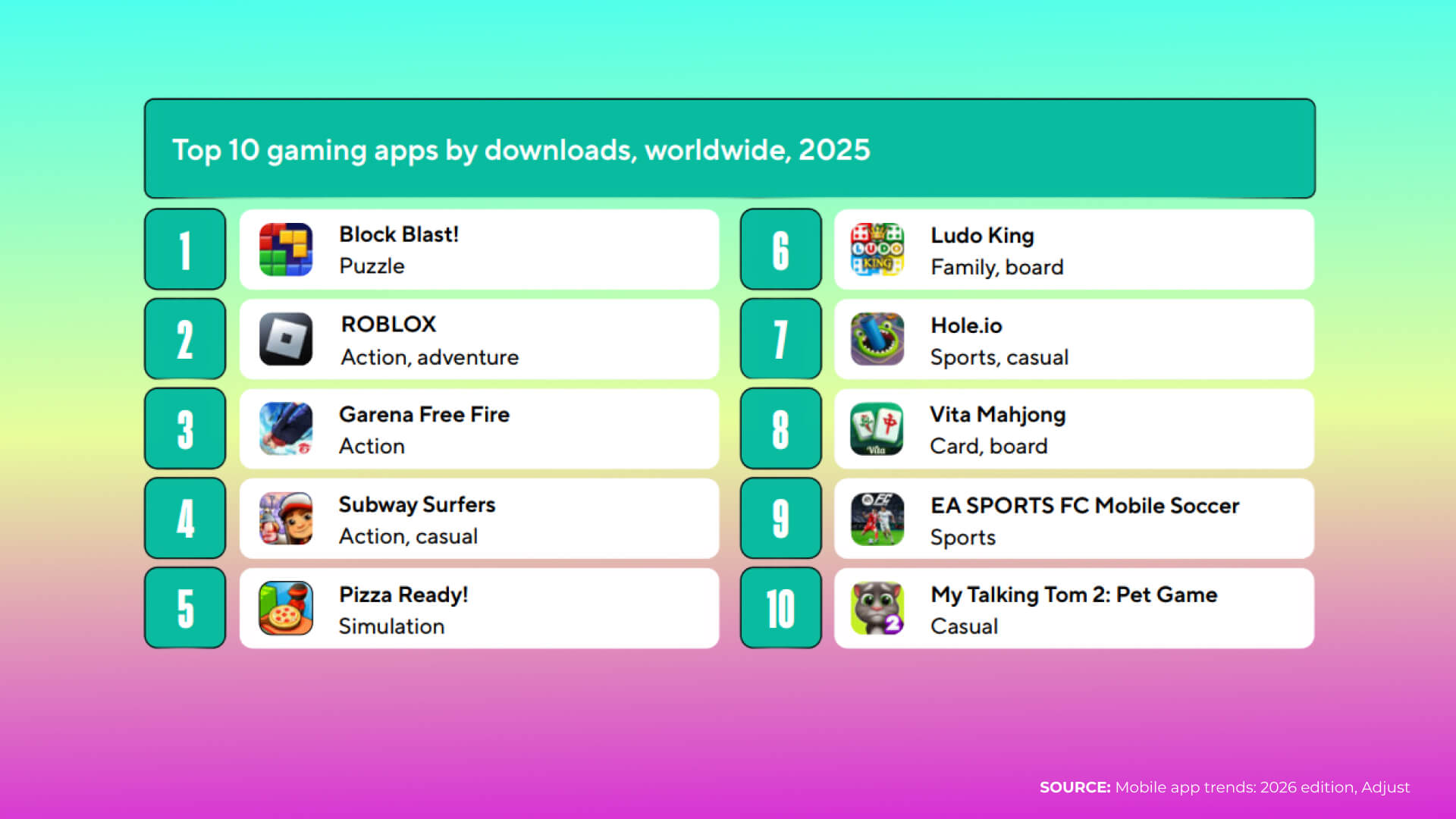
In 2025, hyper-casual games once again became the main driver of installs in mobile gaming. They accounted for 29.1% of all gaming app downloads. However, their share of sessions was much lower — 15.3%.
This clearly reflects the nature of the genre. Hyper-casual games can quickly attract a mass audience, but they do not always retain users for a long time. Their model is often based on high install volumes and monetization through in-app advertising.
Casual and hybrid-casual games each accounted for just over 10% of installs. Puzzle games accounted for 10%, simulation games for 8.5%, and sports games for only 3%.
Racing games showed growth in engagement. The average session length increased by 17% and reached 16.33 minutes. Strategy games stood out even more. In this genre, sessions grew by 57%, while the average session length increased by 18% to 37.51 minutes.
Installs still show the scale of audience acquisition. But sessions and session length help understand how deeply users are engaged in a game.
Why Creatives Need to Be Adapted for iOS and Android
In 2026, creatives need to be adapted not only to the promotion channel, but also to the platform. iOS and Android users react differently to sound, video pace, text, visual accents, and calls to action.
Analysis by Alison.Ai shows that one universal creative for all platforms no longer delivers the best result. Performance depends on the operating system and on specific elements within the ad.
For example, iOS users respond better to:
- Sound-free design.
- An opening shot with a close-up of gameplay.
- Early text with a free offer.
- A large central logo at the end and a direct call to action, such as “Play Now!”.
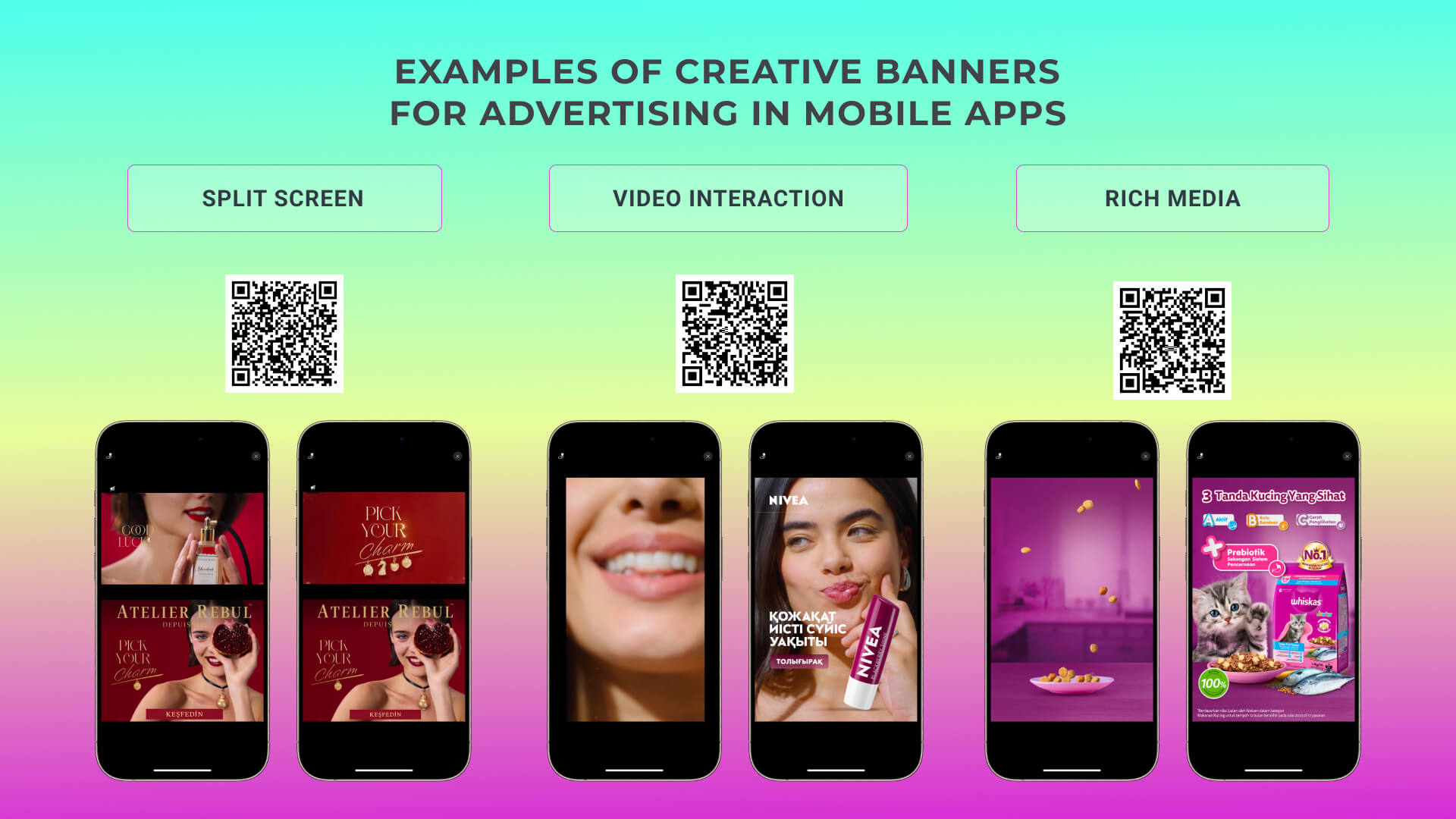
Android users, on the other hand, respond better to more dynamic and visually rich videos. Sound effects, split-screen banners, gameplay demonstrations, and frequent frame changes work well. Visual elements such as falling coins can also be effective.
The Online Shopping App Market in 2026
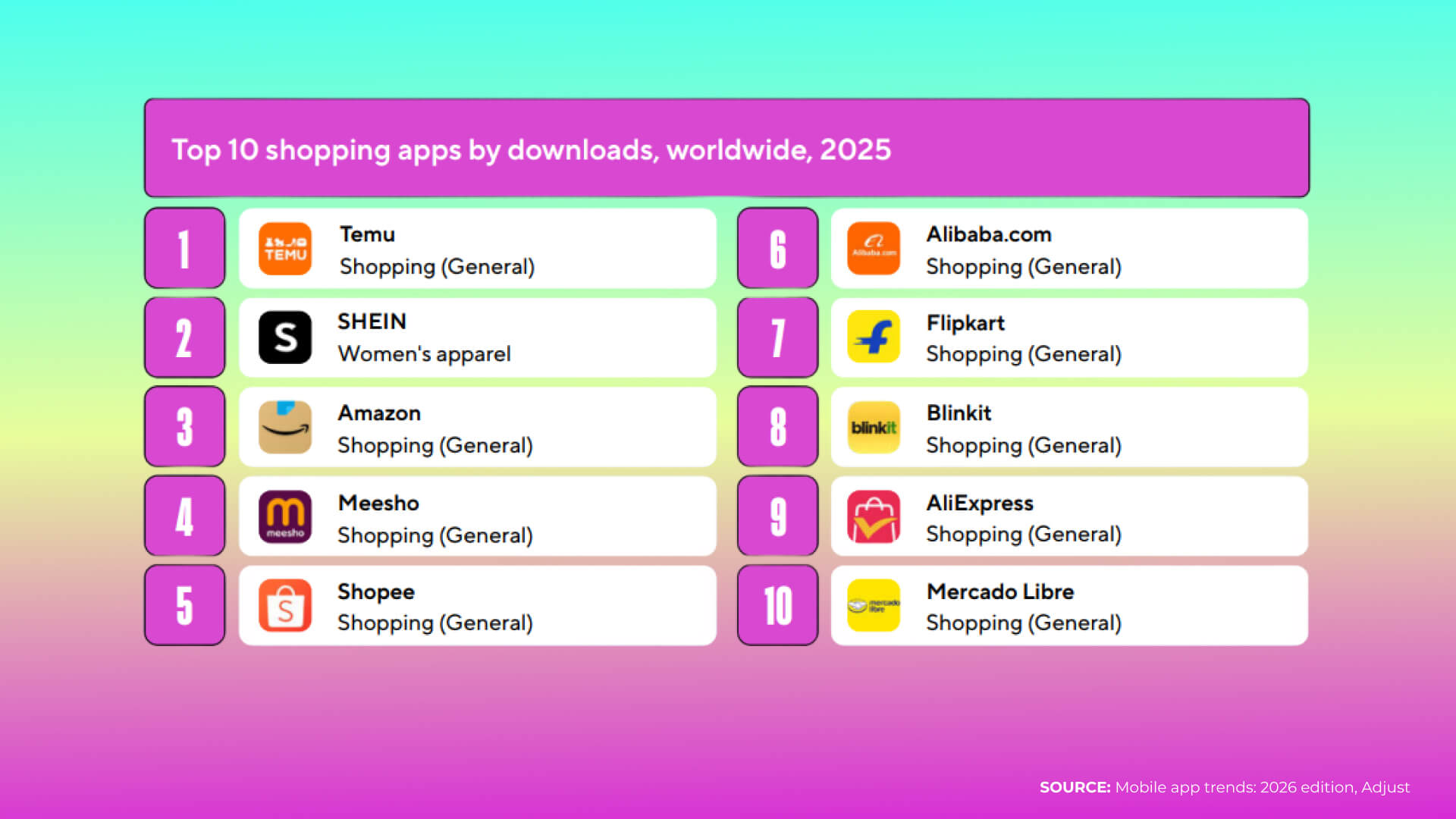
E-commerce continues to grow, but user behavior is changing. From 2019 to 2025, the number of shopping app downloads increased from 4.36 billion to 6.35 billion. Growth over this period exceeded 45%.
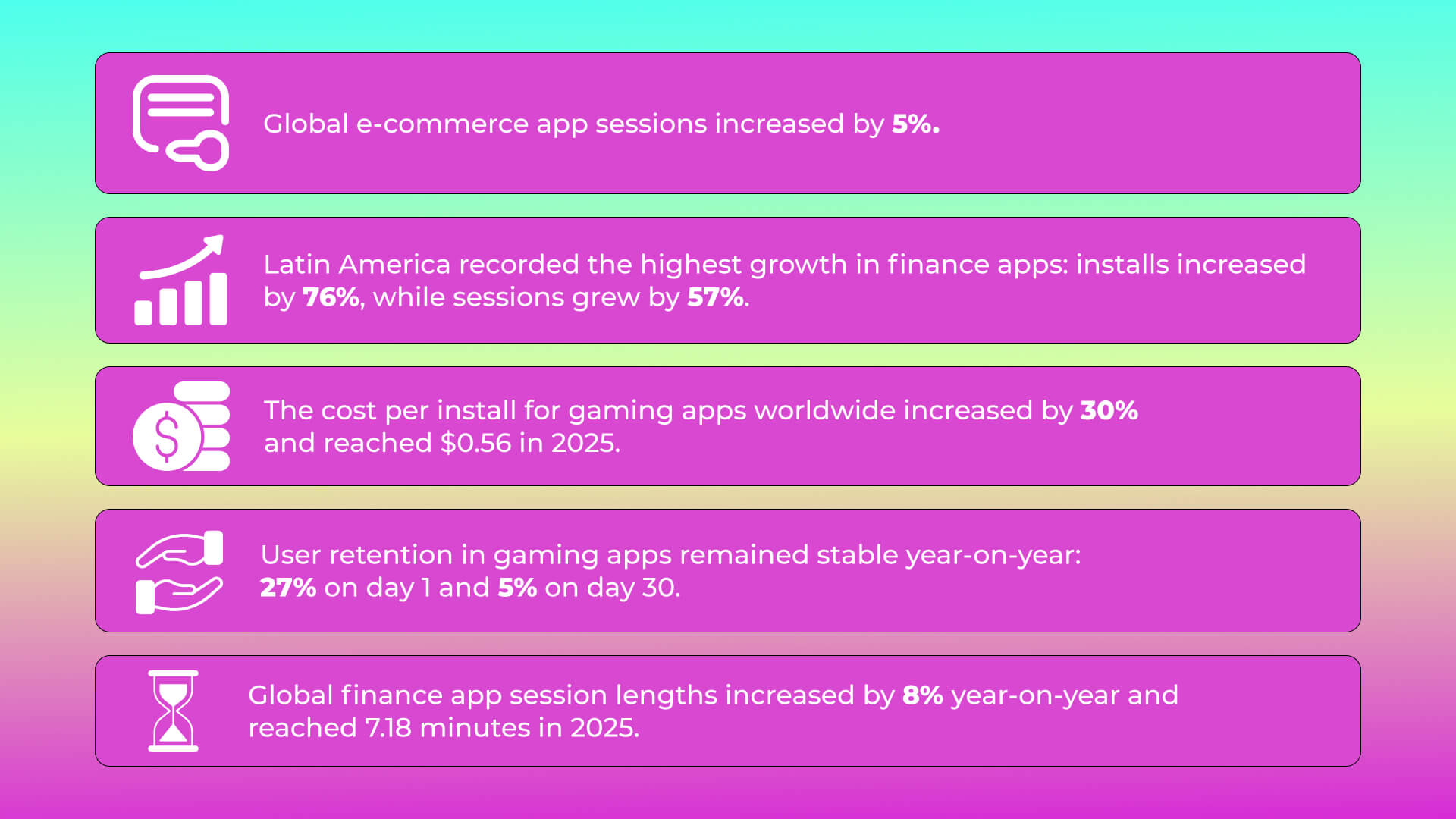
At the same time, the dynamics in 2025 were mixed. App installs declined by 10% year-on-year, while sessions grew by 5%. This means users are installing new apps less often, but are returning more actively to the services they have already chosen.
The most noticeable decline in installs came in February. The figure was 8% below the average level. But by the end of the year, the market recovered. In November, installs were 6% above average, and in December they were 4% above average. Sessions followed a similar pattern.
According to the data, Latin America showed the strongest results. In the region, installs grew by 17%, while sessions increased by 30%. This points to strong growth in mobile shopping and high user engagement.
In the Asia-Pacific region, installs increased by 7%, while sessions remained almost unchanged. The decline was only 0.7%. In Europe, the picture was mixed. Installs fell by 22%, but sessions grew by 6%. This may indicate a more mature market, where users experiment less with new apps but continue to use familiar services.
In the Middle East and North Africa, as well as in North America, both installs and sessions declined.
The Financial App Market in 2026
In 2025, the number of digital wallet users reached 4.5 billion. This shows how quickly mobile finance is becoming part of everyday life.
Users are increasingly choosing services that allow them to manage money quickly and conveniently. Payments, transfers, bonuses, investments, and other functions are gradually being combined within one app.
Against this background, neobanking continues to grow. Neobanking refers to banking services that operate fully or almost fully online, without traditional branches. According to forecasts, the global neobanking market may reach around $13.67 trillion by 2031.
In 2025, several factors influenced the development of fintech apps. These included loyalty programs, the growing popularity of digital wallets, and renewed interest in cryptocurrencies.
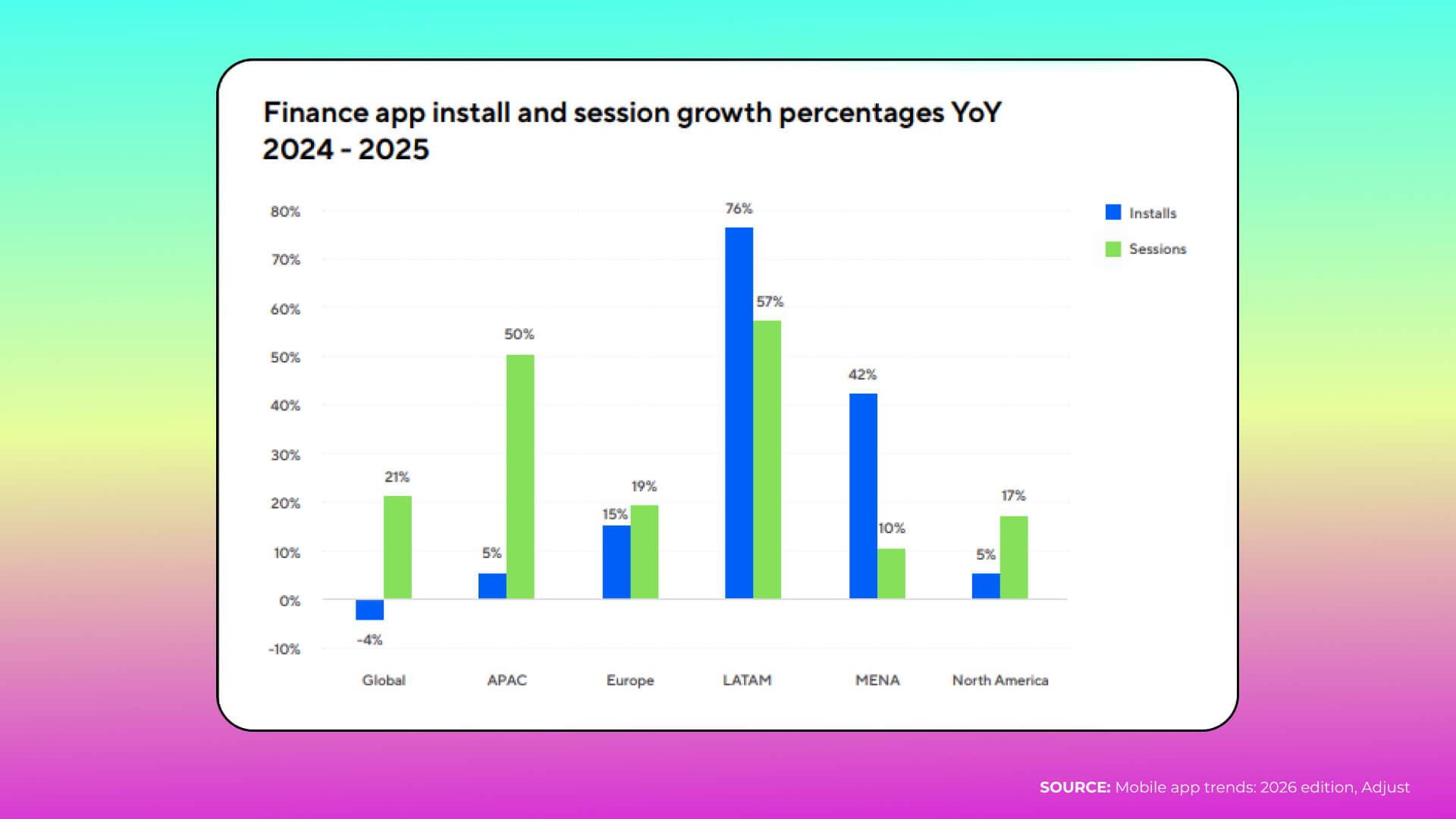
Latin America showed the strongest growth. In the region, fintech app installs increased by 76% year-on-year, while sessions grew by 57%. This indicates not only an influx of new users, but also a high frequency of use.
The Middle East and North Africa ranked second. Here, installs increased by 42%, while sessions grew by 10%.
In the Asia-Pacific region, installs grew moderately by 5%. However, sessions increased by as much as 50%. This may point to stronger engagement among the existing audience.
Europe also showed positive dynamics. Installs grew by 15%, while sessions increased by 19%. In North America, growth was more moderate: installs increased by 5%, while sessions grew by 17%.
Overall, the fintech market is becoming more mature. Users are not just installing financial apps. They are returning to them more often for everyday transactions. For brands, this means that retention, personalization, and a convenient user experience are becoming even more valuable.
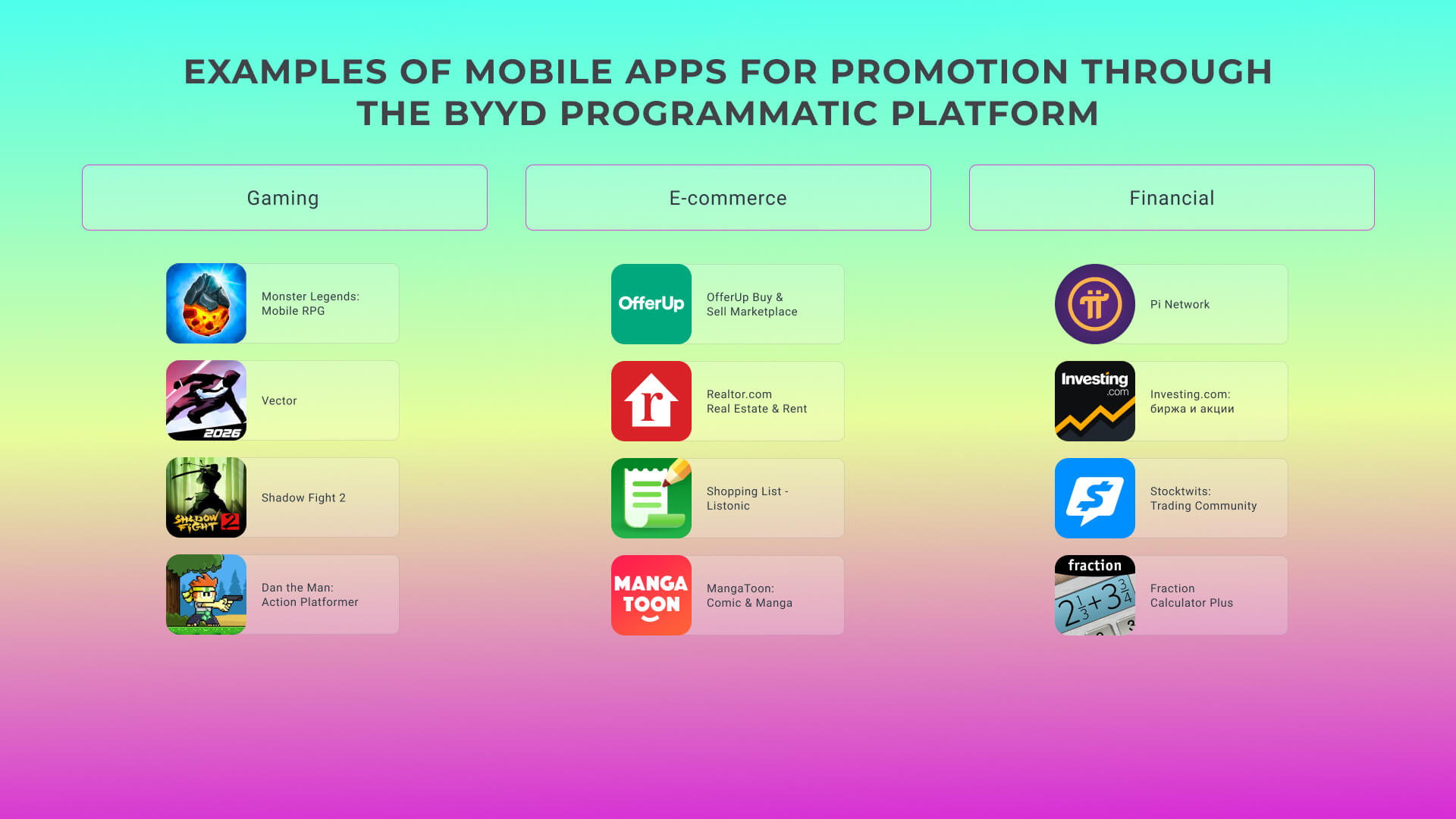
On the BYYD mobile platform, apps for ad placement are not selected randomly. They are chosen according to the goals of each specific campaign. The team takes into account the target audience, geography, ad format, and user behavior in the mobile environment. For more precise audience reach, a White List of apps can be used — a list of approved advertising placements.
After launch, the campaign does not run without control. BYYD specialists analyze platform statistics and external analytics data every day. This helps them understand which apps deliver high-quality traffic, clicks, sessions, and engagement. Placements with low performance are excluded from the campaign, while apps with stronger results receive higher priority in traffic distribution.
The Mobile App Trends in 2026: Outlook
In 2026, the mobile app industry is entering a new stage of development. Relying on one channel or separate metrics no longer gives the full picture. Users freely move between devices, apps, and platforms. That is why growth will depend on how well companies understand the entire user journey.
Data continues to play a key role, but expectations for data are becoming higher. Marketers need not only to collect metrics, but also to connect them across channels and platforms. Cross-channel analytics helps remove blind spots and assess the contribution of each channel more accurately.
At the same time, the role of AI is growing. It helps analyze data faster, find insights, and segment audiences. But the greatest impact comes not from separate tools, but from how they work together as one system.
Frequently Asked Questions
— Does the mobile app market remain promising for brands in 2026?
The mobile app market continues to grow in 2026. Users increasingly interact with businesses, shopping, finance, games, and media content through apps. This makes mobile advertising an important channel for reach, engagement, and long-term communication.
— How does programmatic help brands promote themselves in mobile apps?
Programmatic makes it possible to automatically buy ads in relevant apps and optimize campaigns based on data: clicks, sessions, engagement, and traffic quality. This approach helps brands reach their audience more accurately and allocate advertising budgets more efficiently.
— What trends will influence mobile advertising in 2026?
The main trends will be AI, cross-channel analytics, creative adaptation for different platforms, and more precise audience segmentation. Mobile advertising will become more effective if brands take the entire user journey into account, rather than focusing only on the last click or a single channel.
For over 11 years, the BYYD team has been working with mobile advertising and creating banners designed for real user engagement. We help brands capture audience attention and achieve business objectives through proven mechanics.
Check out our case studies and send us an email – let’s launch your next campaign together.
Found this helpful? Share it with your friends and colleagues!
For consultations and partnership inquiries:
- Submit a request on our website
- Email us at hello@byyd.me