Artificial intelligence has forever changed advertising production. Today, creating an impressive video no longer requires expensive sets, large production teams, or complex computer graphics. However, behind the bright visuals lies a non-obvious challenge for any business — legal security. Creating an impressive asset is only half the work. Much more difficult is turning it into a complete advertising asset that a company has the legal right to use.
That is why professional AI-powered video creation requires solving technical, creative, and legal challenges simultaneously.
In this article, we will explore how BYYD builds a secure workflow. You will learn how to legally create virtual characters and why a properly structured legal chain is just as important as the quality of the final video.
Artificial intelligence already makes it possible to create advertising videos that, until recently, would have required a production set, actors, decorations, and complex CGI production.
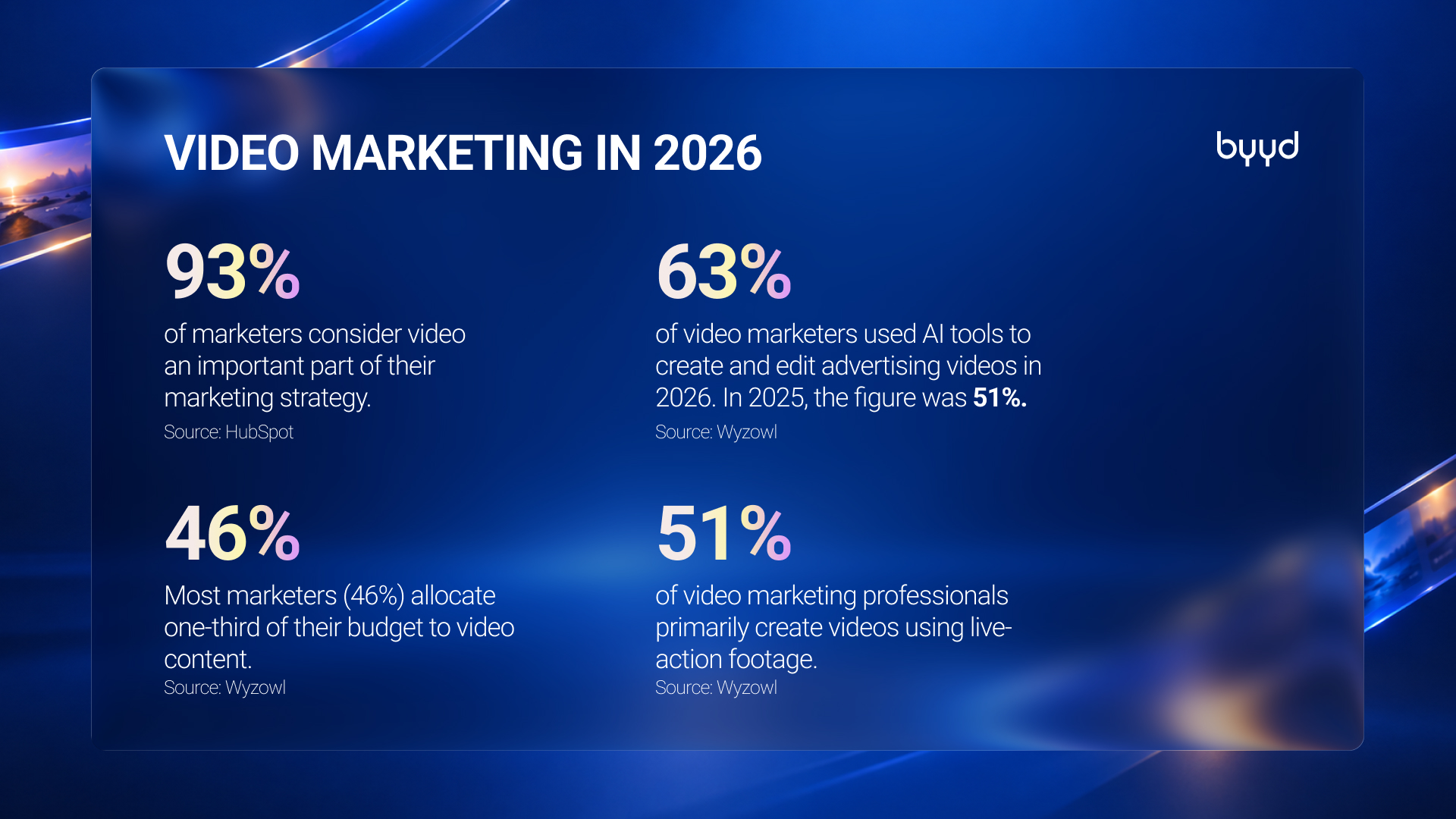
It is possible to develop a visual concept, create a key visual, animate a static product, build a virtual scene, create an original character, synthesize speech, and combine several generations into a complete video.
However, for businesses there is a challenge that is more complex than generation itself.
It is not enough to simply create a beautiful AI video. It is necessary to create an advertising asset that a company actually has the right to use.
Can the video be placed in advertising? Can it be modified six months later? Can it be transformed into banners and new versions? Can the character be used in the next campaign? Can the material be placed in several countries at once? Who owns the rights to the script, editing, graphics, and other elements? What happens to fragments created directly by the generative model?
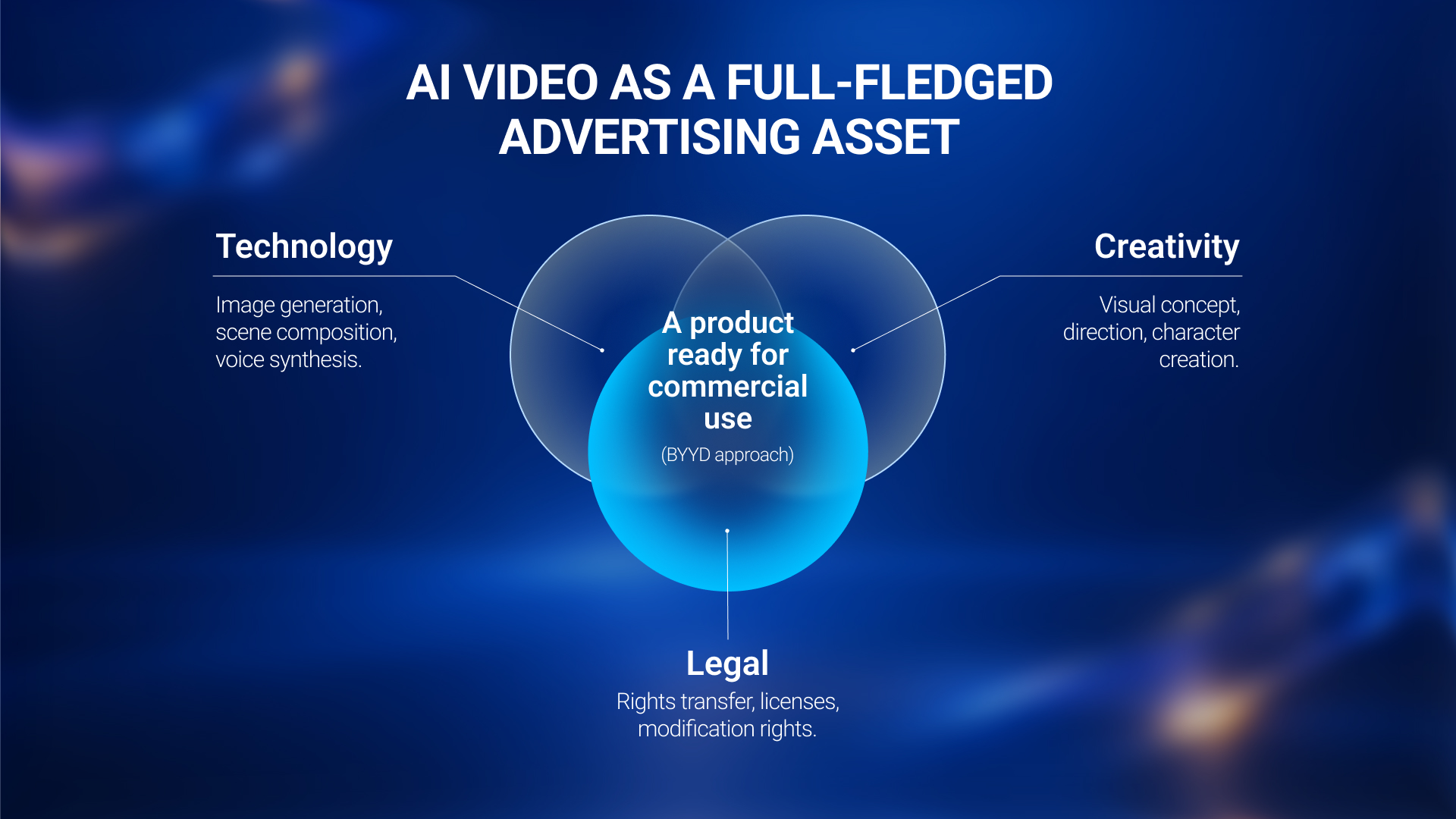
That is why at BYYD we consider AI production simultaneously as a technological, creative, and legal task.
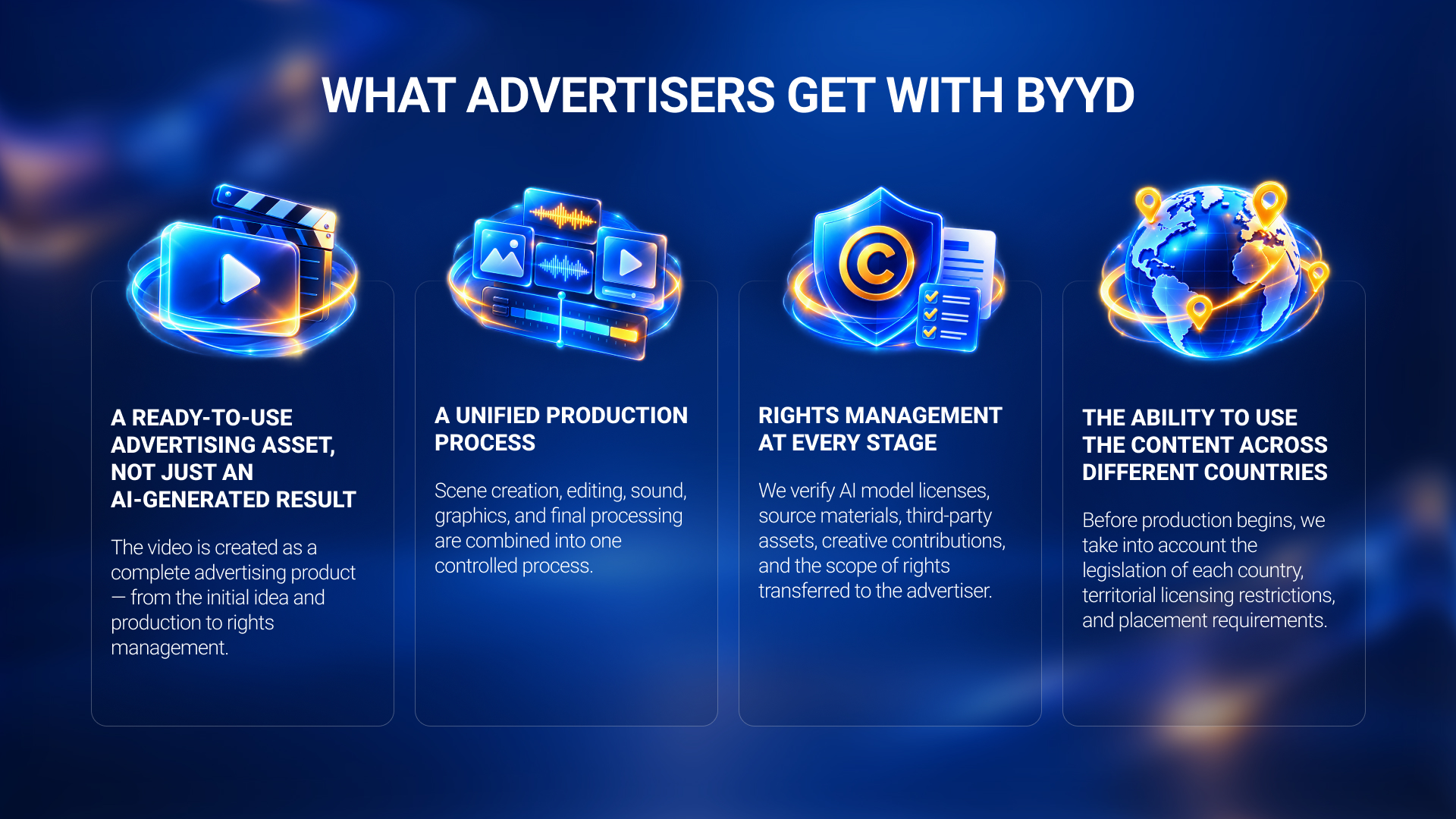
We do not simply generate videos. We build the production process in a way that allows the advertiser to receive a commercially ready creative asset with a predefined rights framework.
For AI video production, we have deployed our own computing infrastructure.
The infrastructure is based on NVIDIA RTX PRO 6000 Blackwell with 96 GB of GDDR7 ECC video memory, AMD Ryzen 9 9950X, 192 GB DDR5 RAM, and high-speed NVMe storage.
This amount of computing power allows us to run resource-intensive generative models locally and combine them into a unified production pipeline.
The workflow includes, for example:
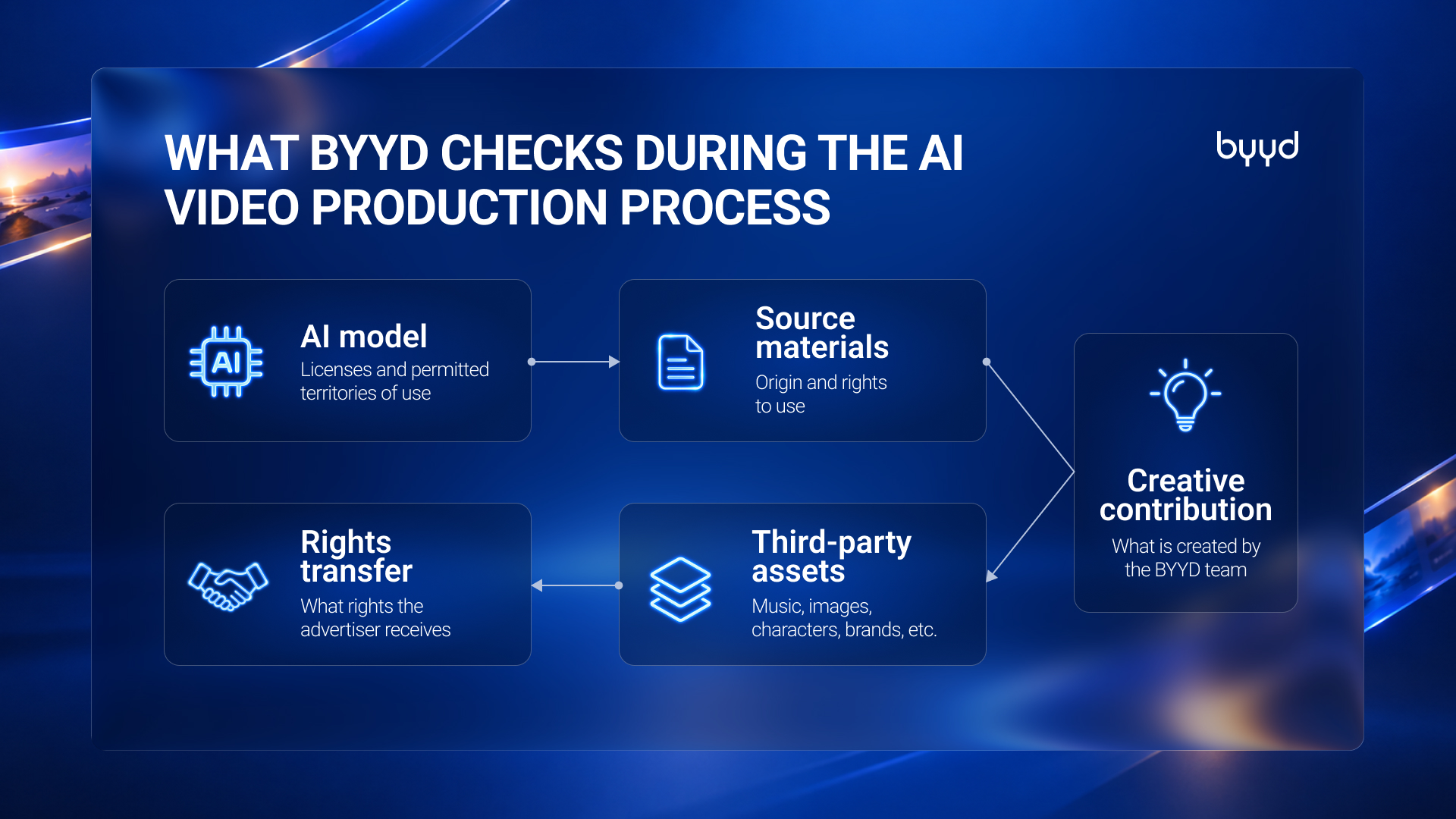
Qwen-Image is distributed under the Apache License 2.0, which allows the use, modification, and distribution of licensed software, including in commercial scenarios, provided that the license requirements are followed.
MiniMax H3 uses a separate Community License, so for this model we separately consider the territory of future placement and other license conditions. In particular, the current version of the license excludes the EU, the United Kingdom, the United States, and the Republic of Korea from the standard territory of its applicability and establishes specific commercial and compliance requirements.
If the geography of a specific advertising campaign goes beyond the territory permitted by the license of the selected model, this is taken into account before production begins: the technology stack can be changed or additional permissions can be obtained.
And this is a good example of why commercial AI production is not simply about choosing the neural network that generates the best image.
It is necessary to understand in advance whether the result of this generation can be used where the advertiser plans to display it.
This is one of the key points that is often overlooked when working with generative content.
Let’s assume that a model is approved for commercial use.
This does not mean that any material created with its help can automatically be used in an advertising campaign without restrictions.
It is necessary to separately understand the legal status of the model itself, the original materials involved in production, the creative contribution of specialists, and each protected element of the final video.
Therefore, at BYYD, legal review begins not after production is completed, but already at the stage of designing the workflow. For this purpose, we:
This creates what is often called in international practice the chain of title — the chain of rights to the created content.
Because legally the concepts of “copyright ownership” and “exclusive rights to a work” are not the same thing.
The legislation of the countries where BYYD operates distinguishes between the author’s personal non-property rights and property rights to a work. The specific terminology and procedure for transferring property rights depend on the applicable legislation.
For example, the legislation of many countries directly establishes that the right of authorship remains with the creator of the work and cannot be transferred (it is inalienable), while exclusive rights can be transferred (assigned) to the client in full under a contract.
The specific contractual structures differ between jurisdictions, therefore the universal formula “we transfer authorship to the client” would not only be an oversimplification but also legally incorrect.
The task of professional production is to handle this differently.
An AI video created in our production process is not the result of a single automated request.
Specialists participate in the creation of the material:
As a result of such creative contribution, legally protected works and/or their elements may arise, and rights to them are formalized within the BYYD production chain.
This is a fundamentally important stage.
Before transferring the result to the advertiser, it is necessary to ensure that the transferring party owns the exclusive rights to the relevant protected results and has the right to assign them to the client.
Otherwise, the client may receive a finished video file but not receive the full scope of rights required for a complete advertising campaign.
For protected results created within the project, exclusive rights are transferred to the advertiser in full under an agreement on the assignment of exclusive rights. The advertiser becomes the rights holder and may use such results in any ways not prohibited by law, dispose of the exclusive rights, and allow other parties to use them. Personal non-property rights of authors remain with the creators; necessary consents for modifications and the procedure for indicating authorship are formalized separately or regulated by the agreement.
For the advertiser, this means much more than simply receiving an MP4 file.
The advertiser receives a contractually formalized advertising asset.
This is the most interesting part of modern AI production.
Copyright legislation has historically been built around human creative contribution. Therefore, it cannot automatically be assumed that every frame created by a generative model becomes an independent copyright object and that a production company can later “transfer copyright” for it to the client.
This is exactly where correctly structured contracts become especially important.
If a separate AI-generated fragment does not receive independent copyright protection, BYYD does not attempt to create an exclusive right by contract that the law may not recognize.
Instead, the contractual structure should provide the advertiser with the broadest possible commercial use of such a result from BYYD’s side: the ability to include it in advertising materials, modify it, process it, combine it with other elements, and use it as part of the final work — taking into account the licenses of the technologies involved and the rights of third parties.
Exclusive rights to protected results of specialists’ creative work are transferred to the advertiser in full. Fragments that do not have independent copyright protection are transferred as part of the final result; exclusive rights to such fragments are not the subject of assignment.
As a result, the legal status of different elements of the video may differ, but the client receives a clear framework for using the final product as a whole.
This is exactly what we consider one of the most complex stages of AI production.
Virtual characters require special attention.
There is a fundamental difference between creating a new character for a brand and using an existing protected character.
BYYD can develop an independent virtual image for the advertiser: its visual style, distinctive features, clothing, environment, and rules for future use.
In this case, the production process is built around creating a new character, and exclusive rights to the results of creative work that meet copyright protection requirements are formalized within the overall project rights chain.
If, however, an existing character from a movie, cartoon, game, illustration, or another work needs to be used in advertising, the fact that an image was created with the help of a neural network does not eliminate the rights of the original rights holder.
In other words, AI does not turn a licensed character into an object free for use.
Therefore, using existing characters requires a separate rights review or an appropriate license, while when developing an original character, BYYD’s task is to create an independent image and correctly formalize rights to the protected elements that have been created.
This is another feature of generative production.
A traditional camera does not have a user agreement that may prohibit displaying captured material in a specific country.
A generative model may have such conditions.
For example, MiniMax H3’s current Community License explicitly establishes the territory of permitted use and prohibits the use and display of H3 Works and results outside the Applicable Territory. The license also establishes additional requirements for large commercial products and services.
In addition, MiniMax H3’s Acceptable Use Policy requires that when information created by the model is distributed in public environments, the machine-generated nature of such content must be clearly disclosed.
Therefore, before production begins, it is important to answer not only the question “which model will provide the best result?”, but also:
“The terms of which model allow this result to be used specifically in our advertising campaign?”
For BYYD, technology licensing is the same part of the production checklist as permissions, video format, or technical requirements of an advertising platform.
BYYD advertising campaigns can be conducted worldwide.
The laws of different countries have common principles of copyright protection; however, the rules for formalizing and transferring rights may differ. This applies, in particular, to requirements regarding the form of agreements, commissioned and employee-created works, conditions for assigning exclusive rights, and specific legal regimes for audiovisual works.
Therefore, for an international campaign, it is not enough to determine once that the use of AI content is permitted.
It is necessary to consider:
These circumstances are taken into account when formalizing the assignment of exclusive rights to protected results created within the project. Restrictions related to third-party materials and the technologies used are separately defined and communicated to the advertiser before production begins.
For AI video production, BYYD uses its own computing infrastructure.
This means that the main generative workflow can be performed without transferring advertiser materials to external public generation services through cloud APIs.
For a commercial project, this is important not only from a technological perspective.
Production may involve images of an unreleased product, new packaging, a future key visual, a campaign script, or other materials that a company would not want to upload to an external generative platform.
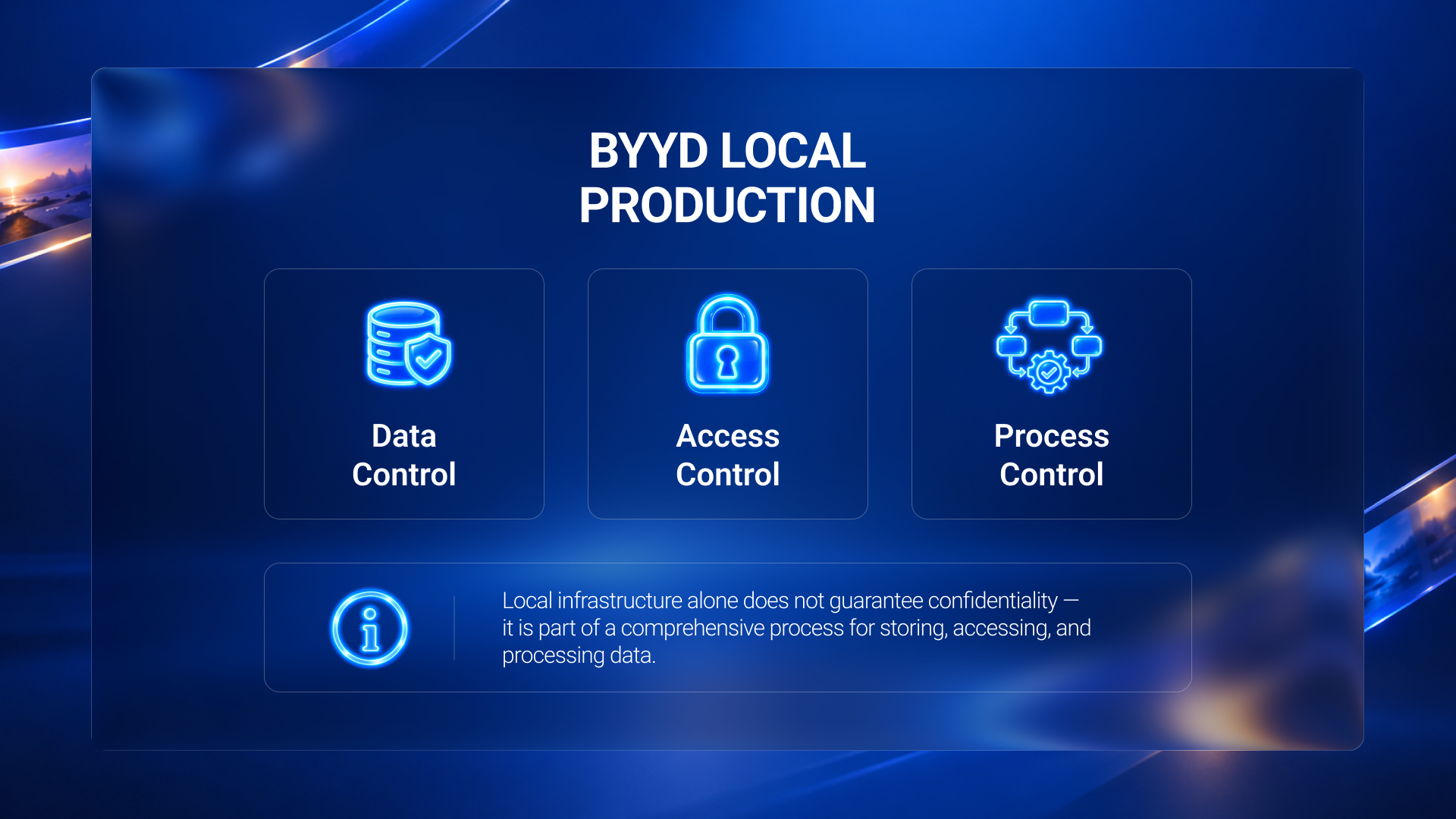
A local environment allows better control over where source data and intermediate generation results are stored, and also reduces the number of third-party services through which project materials pass.
At the same time, confidentiality is ensured not only by the presence of a local GPU but by the entire process of storing, accessing, and processing materials.
Creating a beautiful scene today can be done within several iterations.
It is much more difficult to consistently answer other questions.
Technically, AI production ends after the final render.
For business, it ends only when a clear and continuous chain of rights exists together with the final render.
That is why at BYYD we consider the legal architecture of the project to be part of the production itself, rather than a formality that can be resolved after the video has already been created.
The client receives not just a set of generations and not simply an exported video file.
The advertiser receives finished advertising material and exclusive rights in full to the protected results created within the project. The composition of these results and the moment when exclusive rights transfer are determined by the agreement.
AI fragments that do not have independent copyright protection are transferred as part of the advertising material without claiming the assignment of a non-existent exclusive right.
Rights to source materials, licensed objects, characters, and restrictions of the AI models used are considered separately.
This structure allows AI to be used not only for experiments but also for full-scale commercial advertising.
The use of artificial intelligence itself does not make an advertising video prohibited for commercial use. However, it is necessary to check the model’s license conditions, rights to source materials, protected elements of the result, and legal requirements of the territory where the advertising will be placed.
It depends on the structure of the specific result. Protected elements created through human creative work may generate copyright and exclusive or property rights. Individual fully machine-generated fragments may have a different legal status. Therefore, for a commercial project, what matters is not an abstract phrase such as “AI rights belong to the client,” but a properly structured chain of rights for the entire material.
Yes. For protected results created within the project, exclusive rights are transferred to the client in full under an agreement on the assignment of exclusive rights. Authorship rights and other personal non-property rights remain with the authors. AI fragments that are not protected by copyright are not independent subjects of assignment.
After the transfer of exclusive rights, the client has the right to modify the protected result and create new versions, while respecting the personal non-property rights of authors. Necessary author consents for modifications are arranged when creating the result. That is why BYYD considers not only the first placement of the video but also possible future adaptations, versions, and use of the material in other creatives.
If a new independent character is created, the key issue is the proper formalization of rights to the protected elements created. If an existing protected character is used, creating its image through AI does not eliminate the need to verify the rights of the original rights holder.
Different models are distributed under different conditions. Some allow broad commercial use, while others contain restrictions regarding territory, business size, distribution methods, or AI content labeling requirements. Therefore, the model’s license directly affects where and how the material created with its help can be used.
Generative artificial intelligence is radically expanding the possibilities of advertising production.
It allows brands to create new worlds without physical sets, quickly test visual concepts, develop virtual characters, adapt creatives for different formats, and produce scenes that would be too expensive or technically complicated for traditional filming.
But there is something more important for advertisers.
A beautiful AI video has commercial value only when a company understands on what legal basis it can use it.
That is why BYYD’s approach to AI production is built around three key components: proprietary technological infrastructure, creative work of specialists, and a legally structured chain of rights.
We verify the applicability of licenses for the AI models used in advance, control the origin of materials, formalize rights to protected creative contributions, and define the contractual framework of the final result.
As a result, the advertiser receives not an experiment with a neural network, but a complete advertising asset prepared for commercial use.
For more than 11 years, BYYD has been helping companies with mobile advertising and continuously improving its tools to meet the evolving needs of the market. Check out our case studies and send us an email – let’s launch your next campaign together.
Found this helpful? Share it with your friends and colleagues!
For consultations and partnership inquiries:


