Data Privacy in Mobile Apps: How Users Feel About Advertising and Personalization
In August 2025, Censuswide conducted a study on behalf of Verve, surveying 4,000 mobile users in the US and UK. The goal was to understand what influences users’ willingness to share data.
In this article, we share insights from the 2025 In-App User Privacy Report and explore:
- How users protect their data privacy
- When they are willing to share information
- How personalization affects ad perception
- Which app categories inspire more trust
- How user data improves mobile advertising
Trend #1. Privacy concerns coexist with willingness to share data
Concerns about privacy are growing, but consumers are still willing to allow apps to access information about them under the right conditions.
This is a signal that the industry needs to address consumer concerns directly.
Over the past year, consumers have become less willing to share their names and contact details. At the same time, they have become more open to sharing demographic and contextual data.
The key factors influencing willingness to share data are:
- Transparency: understanding why the data is being used.
- Choice: feeling in control of personal information.
55% of respondents are more likely to share their data if they understand what information is being used and how.
Trend #2. Demand for watching ads in exchange for free content remains strong
Three out of four consumers surveyed said they are willing to watch ads in exchange for free content. This is likely linked to growing global economic uncertainty and subscription fatigue.
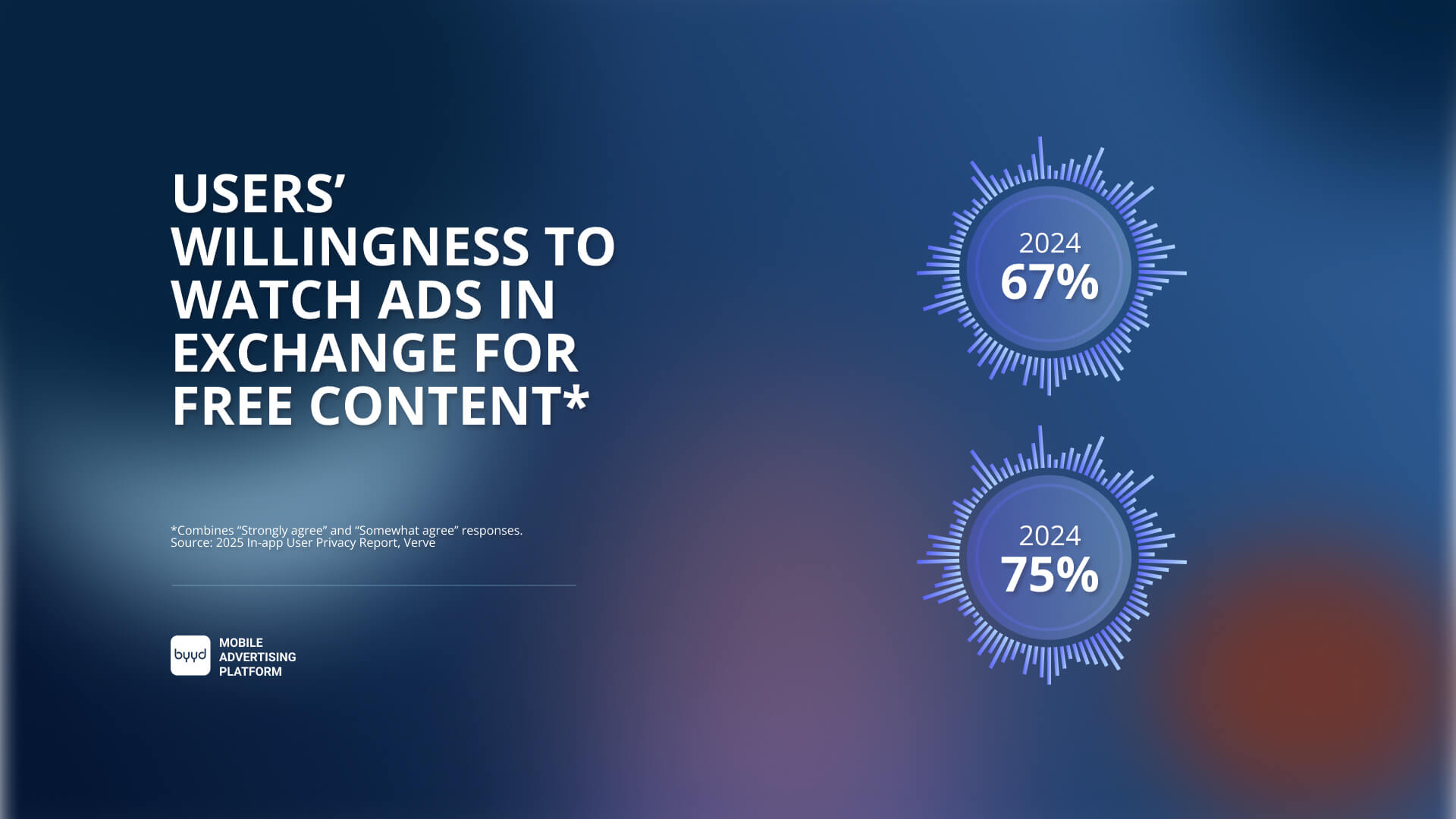
75% of respondents said they are willing to accept ads in exchange for free content, compared with 67% in 2024. This growth reflects a better understanding of the value exchange enabled by advertising.
Trend #3. The development of AI raises privacy concerns
Verve’s survey showed growing consumer concern that app publishers may use their data to train AI. Two-thirds of consumers surveyed said they are more concerned about this than they were two years ago — 65%.
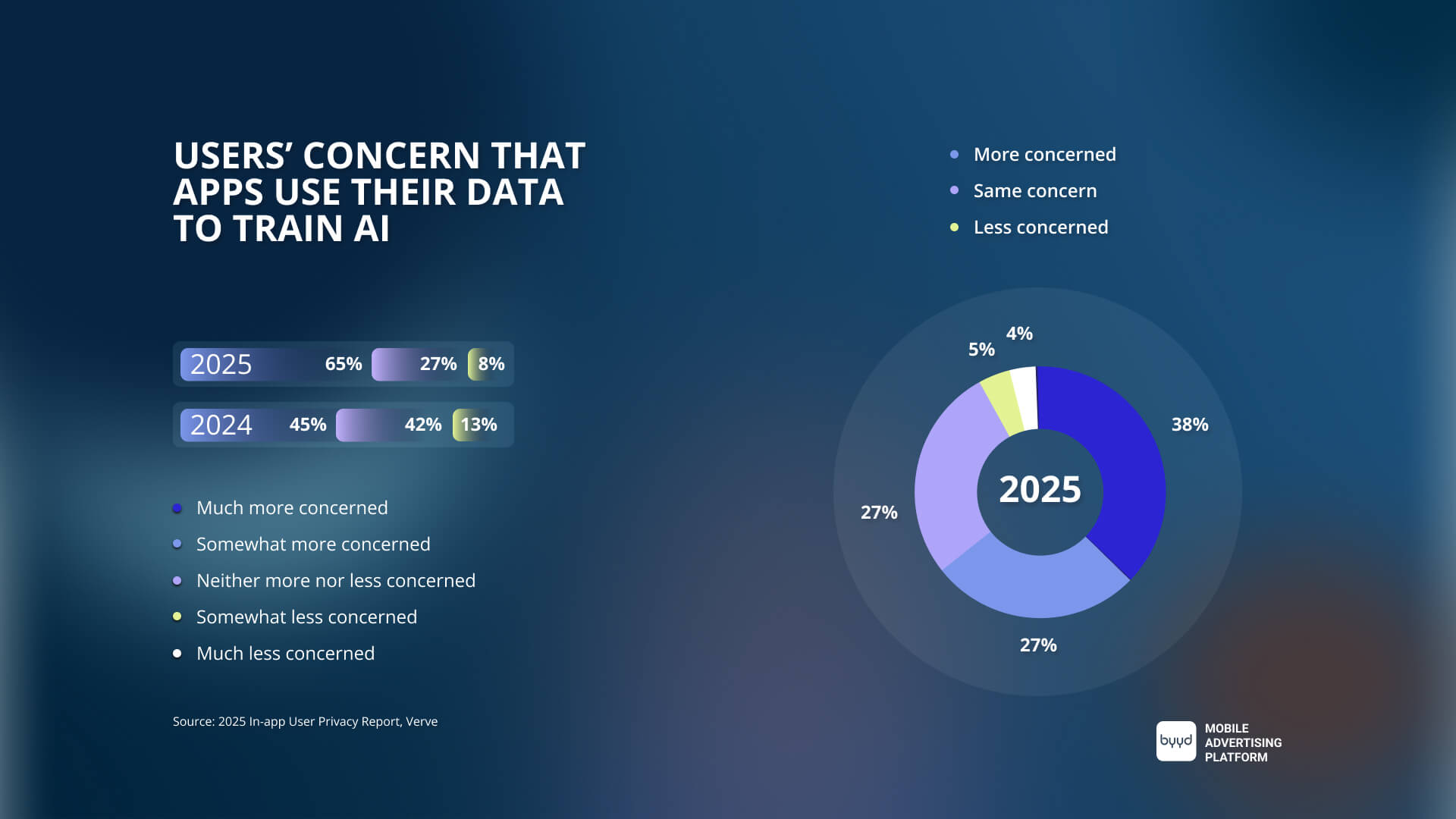
97% of respondents believe that app publishers and platforms need to provide more transparency around how consumer data is used and handled.
Trend #4. Personalization has a positive impact on ad perception
Personalized and relevant advertising is important for proper brand positioning and new product promotion.
According to the survey, three out of four consumers are more likely to pay attention to an ad if it is relevant to them — 76%.
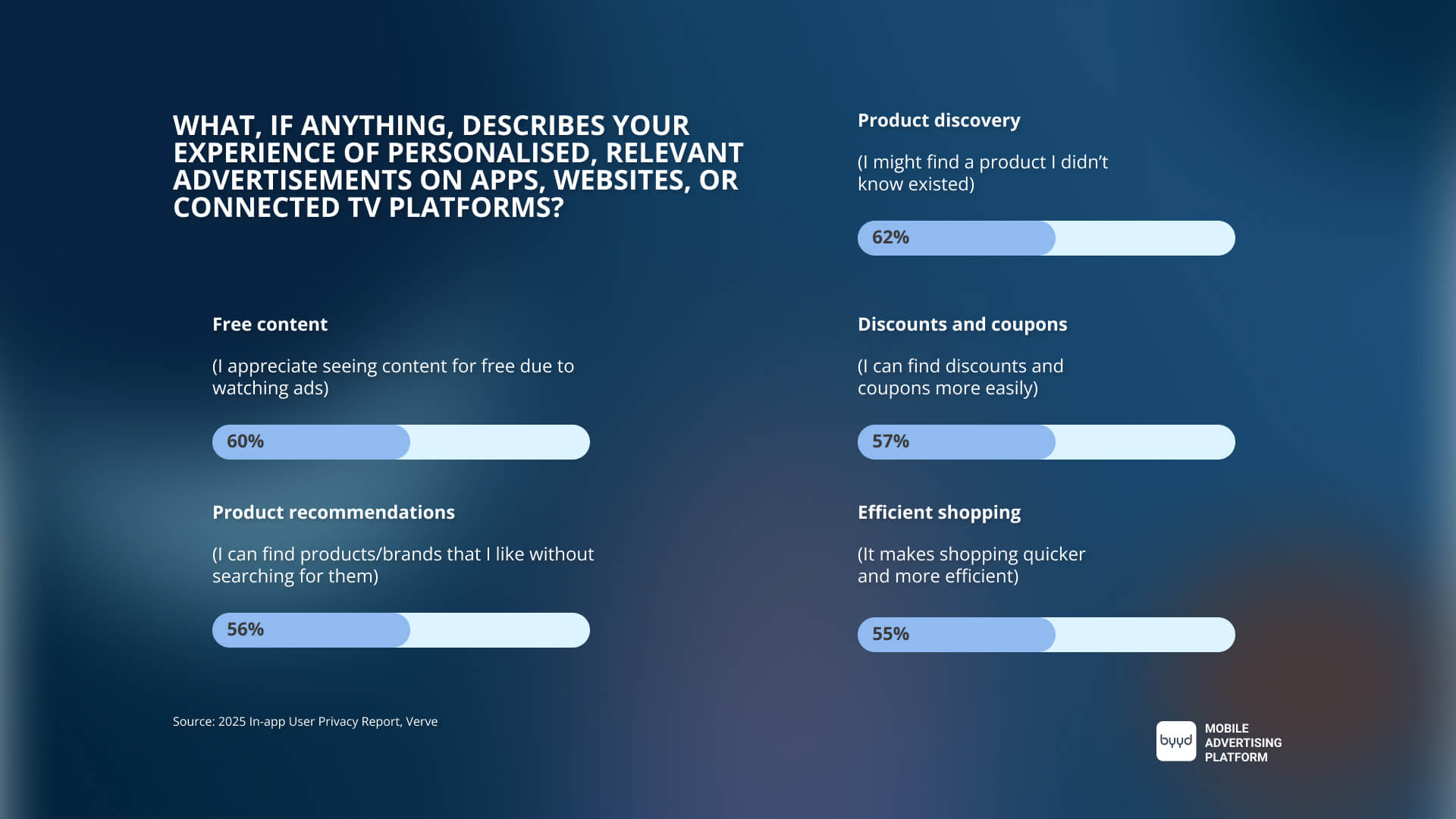
Moreover, two out of three respondents said that relevant advertising helps them discover new products.
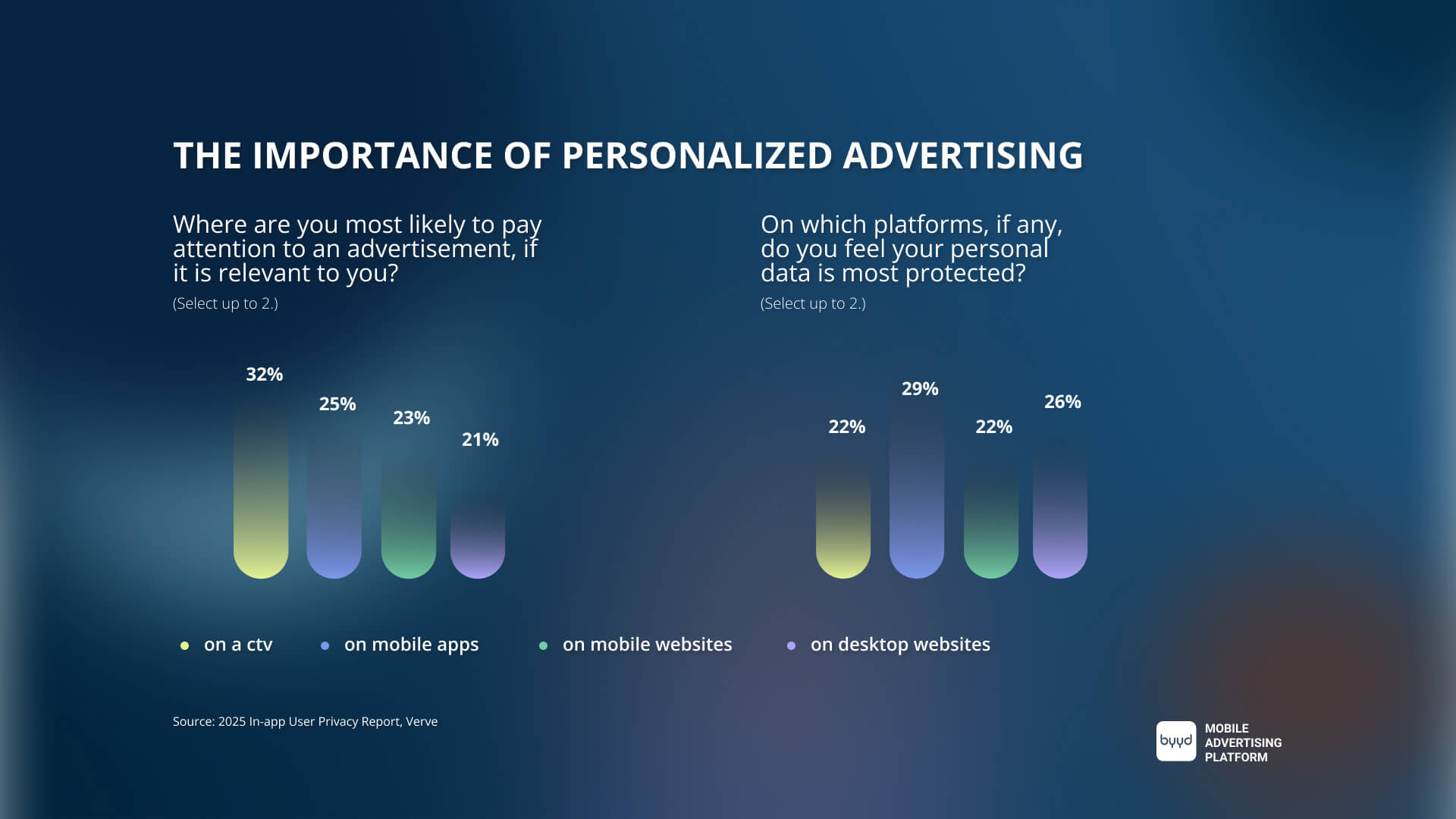
Nearly three-quarters of respondents — 72% — said they would be less likely to pay to remove ads if those ads were targeted and interesting.
At the same time, consumers have mixed feelings about personalized advertising. Users aged 55 and older are more skeptical. In addition, women were more likely to report negative feelings — 53%.
Trend #5. Control over privacy is growing, but trust varies across audiences
65% of respondents said they now feel more in control of their privacy settings. This is slightly lower than in 2024, when the figure was 68%.
At first glance, the decline is small. However, the changes are more noticeable within specific audience groups. Confidence dropped the most among younger users aged 16–24 and the higher-income audience aged 45–54 — in both groups, the decline was at least 10 percentage points.
This suggests that publishers and advertisers cannot rely on one universal approach to data communication. To strengthen trust and increase users’ willingness to share information, different age groups may require different strategies.
The survey also revealed other demographic differences. Women are more cautious about sharing personal data.
For example, 26% of women are willing to share their mobile phone number with finance apps, but only 9% are willing to do the same with news apps.
Trend #6. Users are more willing to share data with mobile apps than with websites
In mobile apps, consumers are more willing to share personal information such as their name, gender, region, and age/date of birth.
Mobile websites performed poorly across most types of data requests.
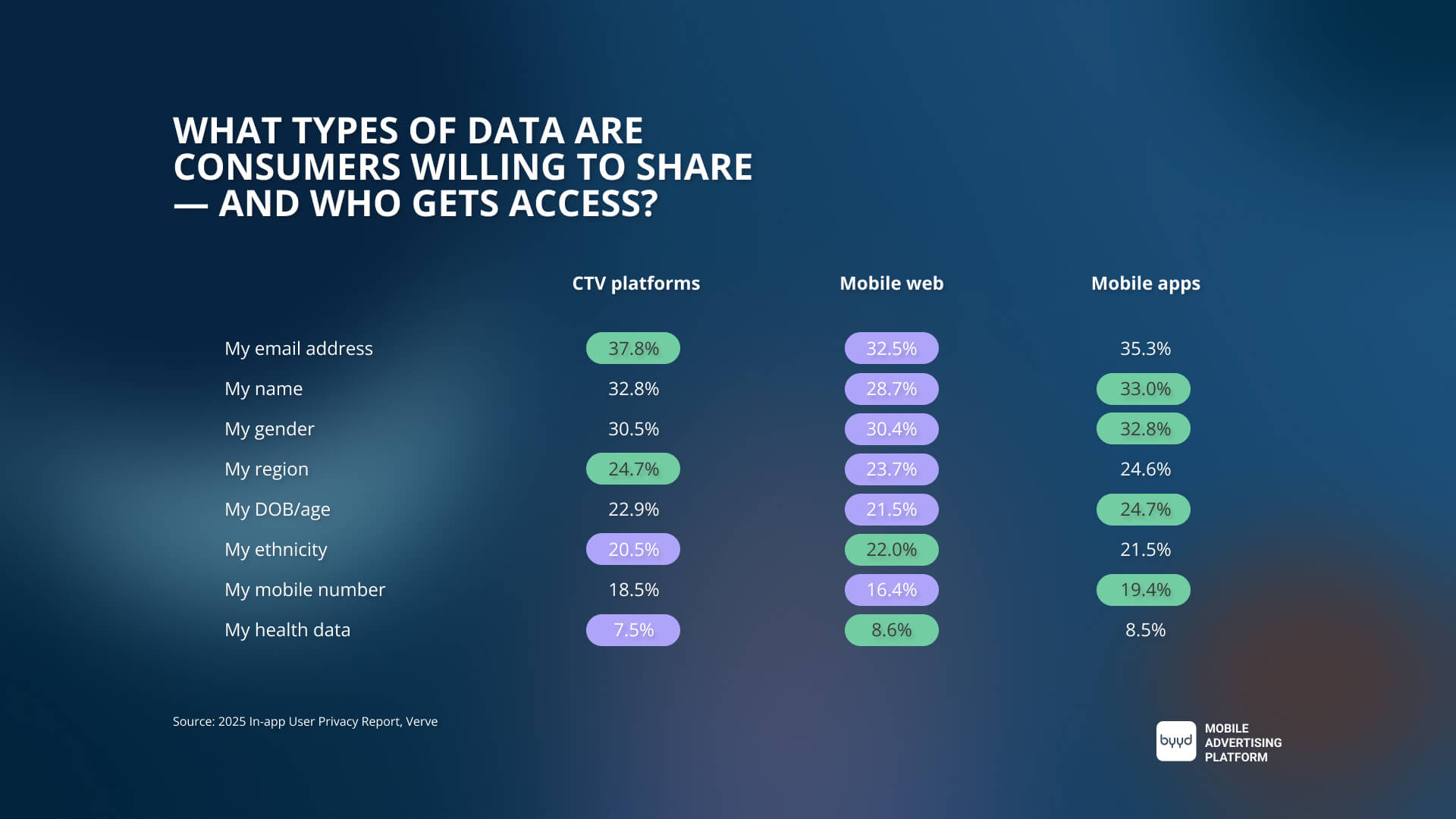
Overall, the survey showed a decrease in willingness to share:
- Name
- Email address
- Mobile phone number
Willingness increased for sharing:
- Health data
- Gender
- Age/date of birth
- Regional information
Trend #7. Shopping apps and streaming services show the highest user willingness to share data
In mobile apps, respondents were least willing to share data with dating apps, games, and news apps.
Shopping apps, social media apps, and streaming services inspire greater trust.
From the user’s perspective, this is logical. In a game, personal information does not play a key role, while in social media it is needed at least for logging in. In shopping apps, sharing data with the publisher is a practical necessity: payment details and delivery information are required to purchase a product.
Dating apps remain the category with the highest level of privacy sensitivity. 54% of users are not willing to share any personal data with them.
How user data is used in mobile advertising
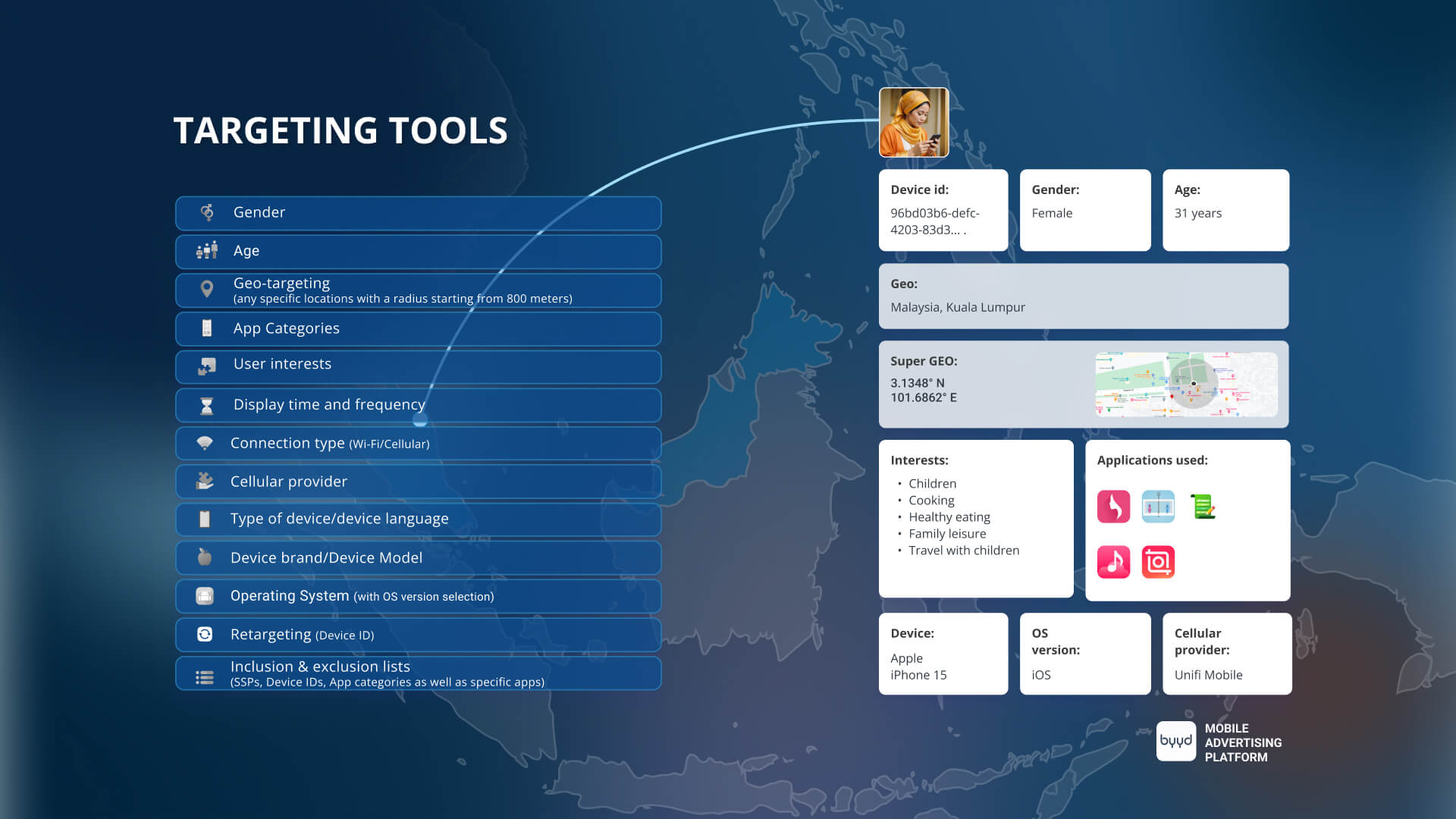
A device identifier, or Device ID, is a unique anonymous number. In mobile advertising, it helps identify target audiences and segment them by interests in order to deliver advertising messages more accurately.
On iOS, access to the device identifier is only possible with explicit user consent. In Android settings, users can opt out of personalized advertising, which deactivates access to the identifier.
User data helps show ads not to a random audience, but to those who may actually be interested in the product. By using information about interests and behavior, brands can make communication more precise.
When ads are shown to irrelevant users or repeated too often, they start to feel intrusive. Using data reduces the number of ineffective contacts. As a result, users are less likely to encounter unnecessary advertising, while brands reduce the risk of causing irritation.
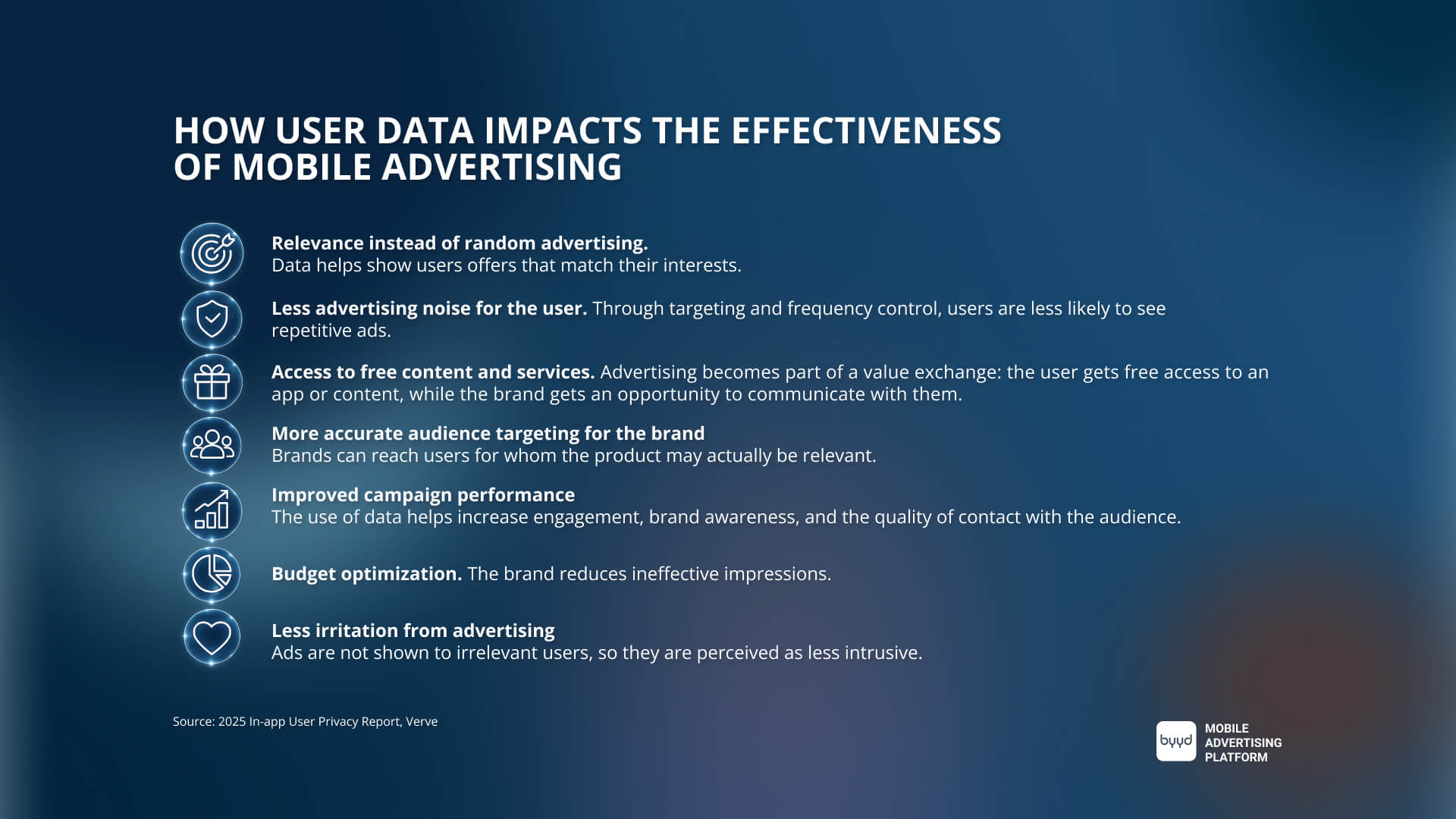
How BYYD responds to trends in users’ attitudes toward advertising and data privacy
1. Ad relevance affects campaign performance. That is why, when planning promotion, BYYD digital marketing specialists take into account the socio-demographic parameters of a brand’s target audience, as well as users’ interests and online behavior. Based on this, suitable apps for advertising are selected.
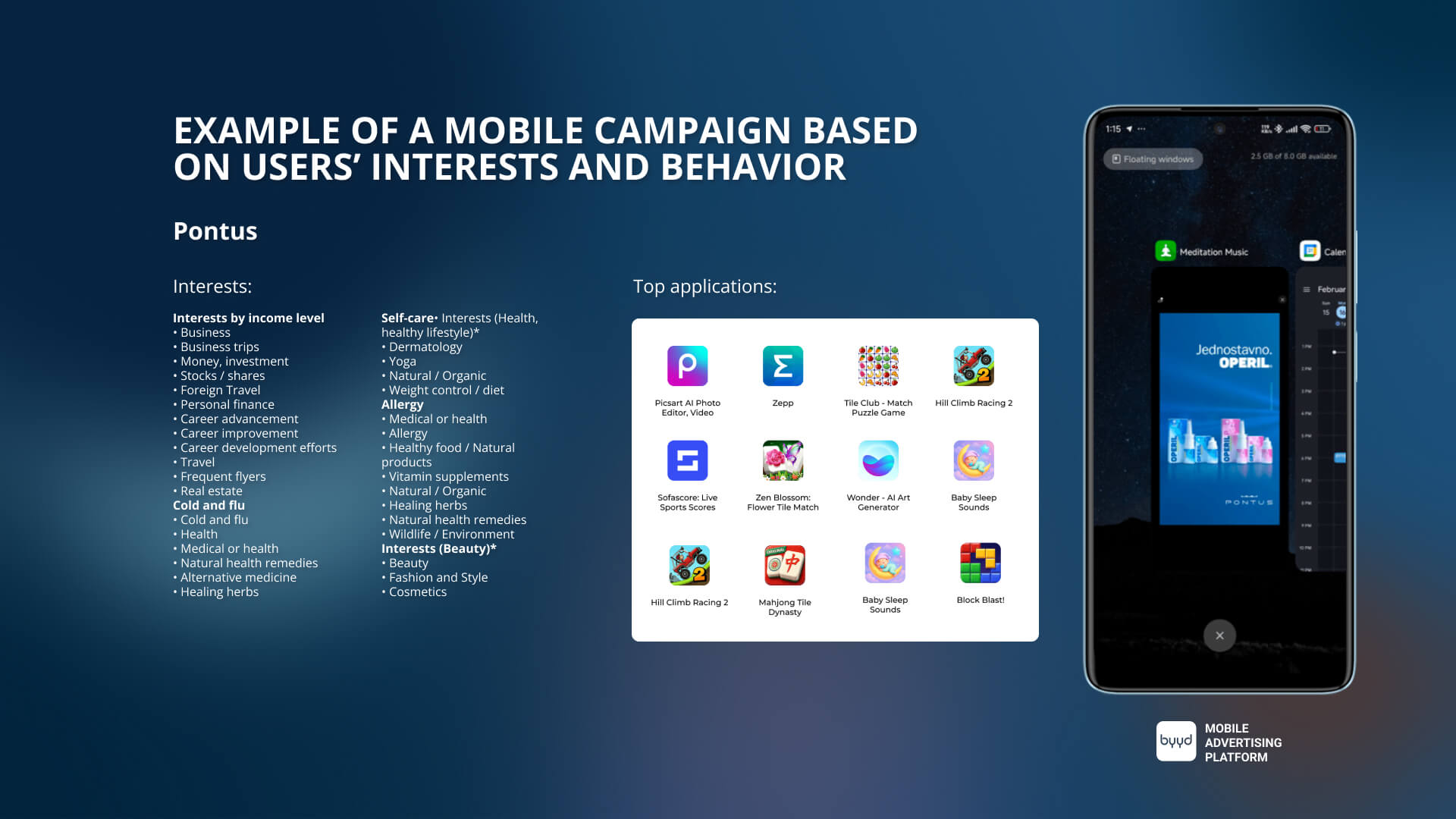
2.Context influences brand positioning. Nearly half of respondents said that relevant advertising, for example, a sports ad in a sports app, is the most appealing to them. Meanwhile, 49% of respondents said that a contradictory ad placement, for example, a beauty product ad in a sports app, would reduce their willingness to interact with the banner.
The example is the promotion of the Pontus medicine. BYYD digital marketing specialists focused on users who may have cold symptoms, suffer from allergies, and care about their health. Carefully selected apps helped reach around 600,000 unique users in the Serbian market.
3.Value in exchange for watching ads. Verve’s survey also confirmed the importance of value-exchange ad formats. In this context, rewarded video advertising is especially relevant. Read more in the article.
4. Benefits for users. Discovering new products and learning about discounts can have a positive effect on communication with consumers. Mobile advertising helps solve brand awareness tasks and inform users about relevant offers.
Thus, without context and without incentive, people almost always choose privacy. But when the request is made clearly and includes a specific benefit, many more users are willing to share at least part of their personal information.
How to contact us
For over 11 years, the BYYD team has been working with mobile advertising and creating banners designed for real user engagement. We help brands capture audience attention and achieve business objectives through proven mechanics.
Check out our case studies and send us an email – let’s launch your next campaign together.
Found this helpful? Share it with your friends and colleagues!
For consultations and partnership inquiries:
- Email us at hello@byyd.me
- Submit a request on our website