How BYYD Controls Advertising Traffic Quality: AI Anti-Fraud
According to statistics, 8.51% of all paid advertising clicks are invalid traffic. This equals $63 billion in global advertising budget losses. In other words, campaign efficiency and advertiser spending directly depend on the quality of incoming traffic.
The digital market is facing increasingly sophisticated forms of fraud. It is no longer limited to traditional bot traffic — fraud is now organized using machine learning and adaptive behavioral scenarios.
Without reliable control mechanisms, advertising campaigns become vulnerable to invalid impressions, clicks, and conversions. This reduces ROI and increases spending without real growth in audience or sales.
The BYYD mobile platform has developed an AI-powered anti-fraud system that reduces invalid traffic to minimal levels. Below, we explain how it works and share analytics.
Intelligent Advertising Traffic Protection System
BYYD AI Anti-Fraud is a comprehensive fraud protection system for advertising campaigns. It is built on a proprietary machine learning model and processes more than 1.5 billion bid requests per day.
In real time, the platform:
- Analyzes incoming traffic
- Builds a digital user profile (fingerprint)
- Makes an auction participation decision in ~0.4 milliseconds (from bid request receipt to decision)
The architecture is currently deployed on a dedicated anti-fraud server (48 CPU / 256 GB RAM). Each bidding server runs a separate anti-fraud service process consuming ~2 CPU.
This allows the system to scale efficiently with virtually no impact on bidder performance.
System Architecture
1. Real-Time Machine Learning
The ML model (CatBoost) processes large datasets containing a wide range of behavioral traffic characteristics. Training is conducted on real user activity data. The dataset is structured to include maximum diversity of patterns — both fraudulent and legitimate.
Once trained, the model is deployed into the production environment where it:
- Processes every incoming request
- Calculates required behavioral and technical features
- Assigns a fraud score between 0 and 1
The threshold can be adjusted depending on the required balance between aggressive filtering and reach preservation.
Model Quality Metrics
To evaluate performance, key binary classification metrics are used: precision and recall.
— Precision reflects the share of correctly identified fraud among all traffic classified as fraud.
Formula: Precision = TP / (TP + FP), where:
TP (True Positive) — correctly detected fraud
FP (False Positive) — legitimate traffic incorrectly classified as fraud
— Recall reflects the share of detected fraud out of the total actual invalid traffic.
Formula: Recall = TP / (TP + FN), where:
TP (True Positive) — correctly detected fraud
FN (False Negative) — fraud not detected by the model
Current Offline Validation Results
- Precision = 0.92
- Recall = 0.95
This means the system detects 95% of fraudulent traffic while maintaining high classification accuracy and minimizing false blocking of legitimate users.
2. Fingerprint: Digital User Profile
Each user is assigned a unique digital fingerprint.
If a Device ID (IFA/GAID) is available, the profile is linked to it.
If not, a unique platform ID is generated based on a combination of parameters, including:
- device_ip
- device_make
- device_model
- device_os
- device_osv
- device_ua_core
This enables probabilistic device identification even without an advertising identifier.
3. Handling Dynamic Changes
In real environments, users often:
- Change IP addresses (dynamic networks)
- Update operating systems
- Modify User-Agent
- Switch between mobile and wired internet
If a new fingerprint is created (e.g., due to IP or UA changes), ad serving becomes possible only after re-verification in subsequent auctions with the same parameters.
This allows the system to:
- Correctly merge the same user
- Minimize false positives
- Effectively counter fraud masking attempts
4. Basic Traffic Filters
Before ML evaluation, the system applies base filtering:
- Blocked domain lists
- Domains from the Russian regulator’s prohibited resources API
- IP addresses of known cloud services
- Known proxies and data centers
This removes obvious fraud before deeper analysis.
Behavioral and Technical Evaluation: 20+ Parameters
After initial filtering, each bid request undergoes multi-level evaluation based on 20+ parameters.
- Device and ad slot size
Minimum height/width must exceed a threshold (X pixels) to prevent invisible placements.
- Mobile carrier presence
Missing operator data may indicate anomalous traffic.
- User-Agent validation
Checked for:
- Minimum length
- Device model consistency
- OS match
- Bid request data consistency
- VPN and proxy traffic
Blocked based on:
- Network data
- App name
- Bundle ID
- VPN signatures
- Average pause between requests
The time interval between bid requests from a single digital profile (fingerprint) is analyzed. Too frequent or overly regular intervals signal automated behavior.
- Maximum request volume
Exceeding limits results in system-level fingerprint blocking, with potential review.
- IFA/GAID changes
Sudden advertising ID changes within one fingerprint suggest manipulation.
- Burst detection
Request volume is compared to the median of similar devices within the same bundle ID. Sharp deviations indicate bot behavior.

Real Campaign Statistics
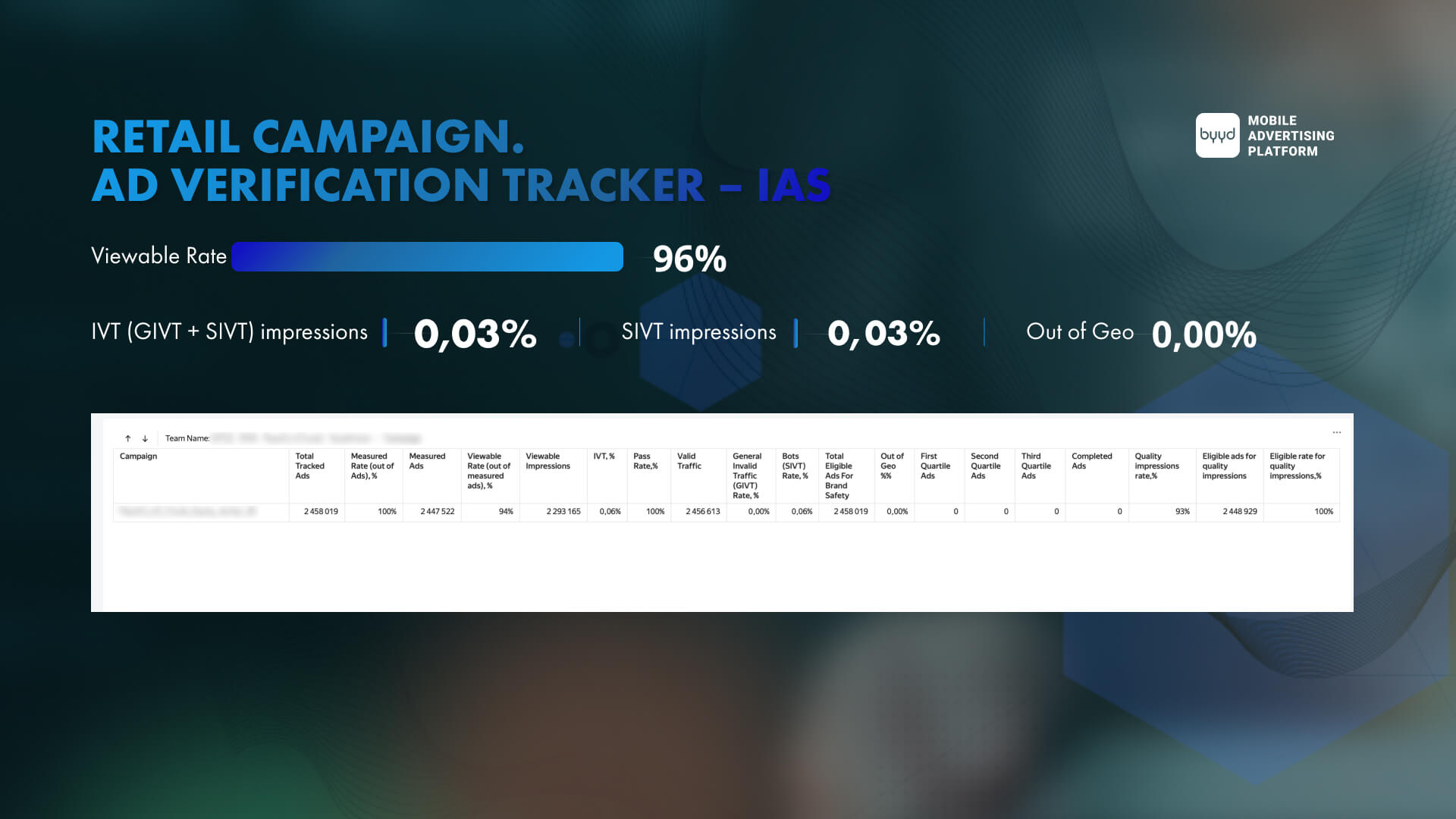
The campaign performance in the retail segment demonstrates a high level of advertising traffic quality. A Viewable Rate of 96% significantly exceeds market benchmarks, indicating strong visibility of the ad placements. At the same time, the invalid traffic rate is only 0.03%, and no impressions were recorded outside the target geography, confirming accurate targeting and the effectiveness of fraud-prevention controls.
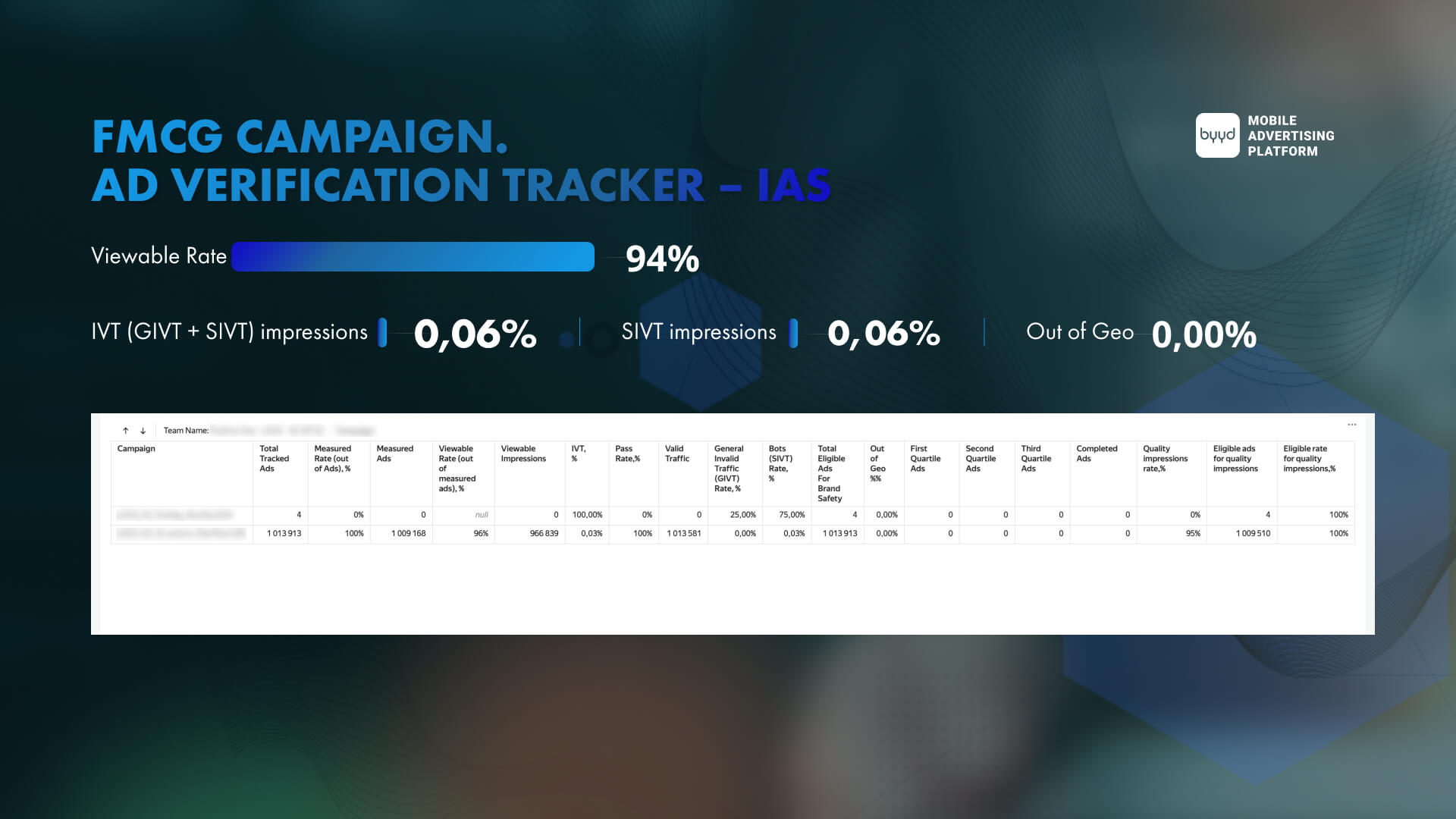
The FMCG campaign has demonstrated a high level of quality in its advertising traffic. With a Viewable Rate of 94%, the campaign shows strong visibility, surpassing the standard market expectations. Furthermore, the overall level of invalid traffic (IVT) was only 0.06%, which is acceptable for large-scale advertising campaigns, considering the size of the audience.
Additionally, no impressions were recorded outside the target geography (0.00%), which highlights the accuracy of the targeting and the effectiveness of the fraud prevention measures implemented in the campaign.
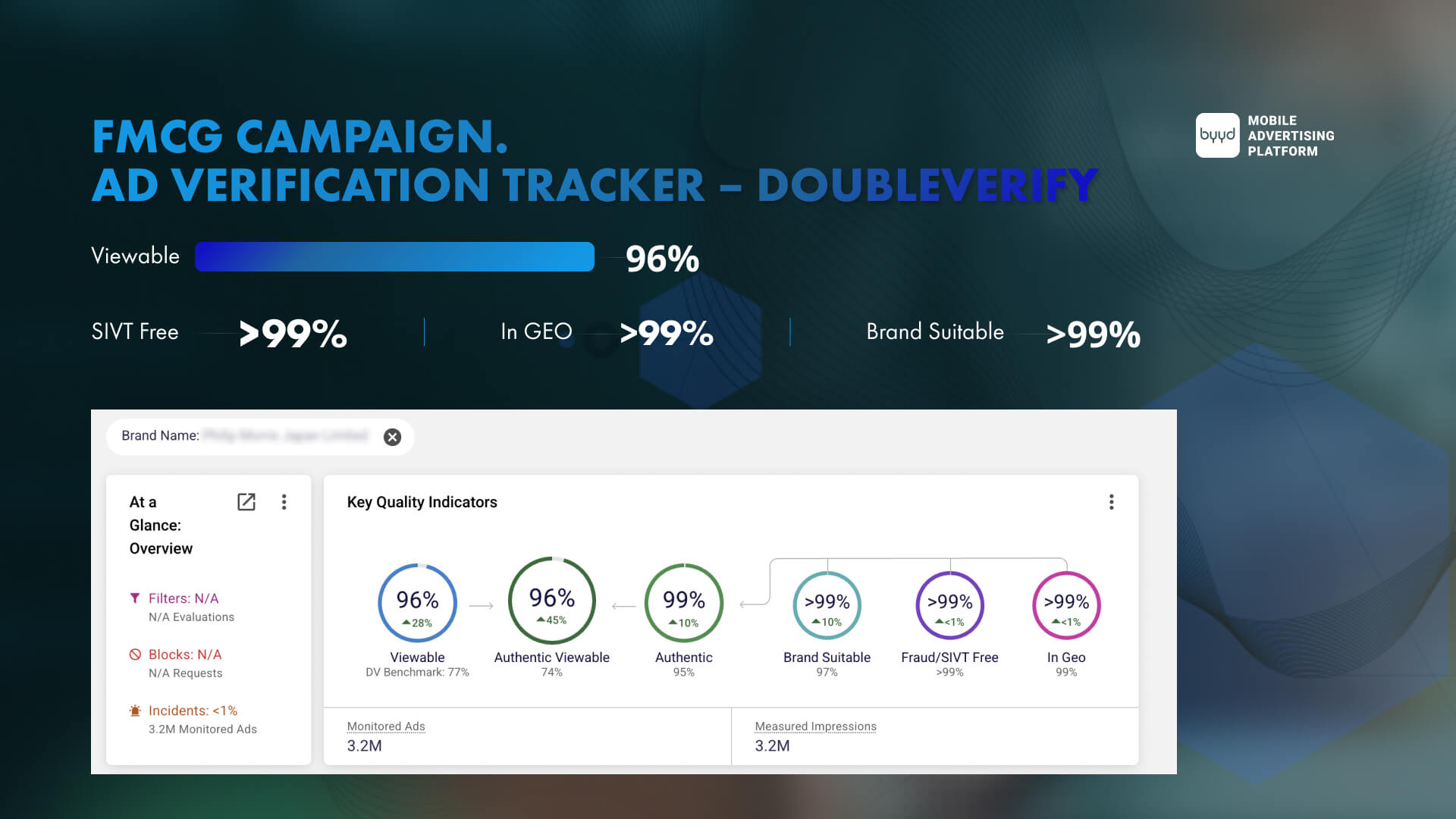
The verification results of the FMCG campaign, using the DoubleVerify tracker, demonstrate a very high level of placement quality. 96% of impressions were viewable, and the share of impressions free from Sophisticated Invalid Traffic (SIVT) exceeds 99%, indicating the near absence of fraud.
Additionally, more than 99% of impressions were delivered within the target geography and met Brand Suitability requirements, confirming accurate campaign setup and ad placements in a brand-safe environment.
Key Advantages of BYYD AI Anti-Fraud
- 1+ billion requests processed daily
- Continuously retrained model
- Real-time decisions without auction speed loss
- A persistent digital profile (fingerprint) even without a device identifier (Device ID)
- Behavioral analysis beyond static filters
- Flexible blocking and permanent restriction mechanisms
BYYD AI Anti-Fraud is not just a filter set — it is an intelligent dynamic traffic evaluation system capable of detecting complex fraud schemes in real time.
By combining machine learning analytics, behavioral pattern recognition, and strict technical criteria, the system ensures maximum transparency and advertising campaign quality.
Contact Us
For over 11 years, BYYD has been helping brands succeed in mobile advertising while continuously improving its technologies. Check out our case studies and send us an email – let’s launch your next campaign together.
Found this helpful? Share it with your friends and colleagues!
For consultations and partnership inquiries:
- Submit a request on our website
- Email us at hello@byyd.me