Digital Marketing in Armenia 2026: Key Trends and Expert Insights
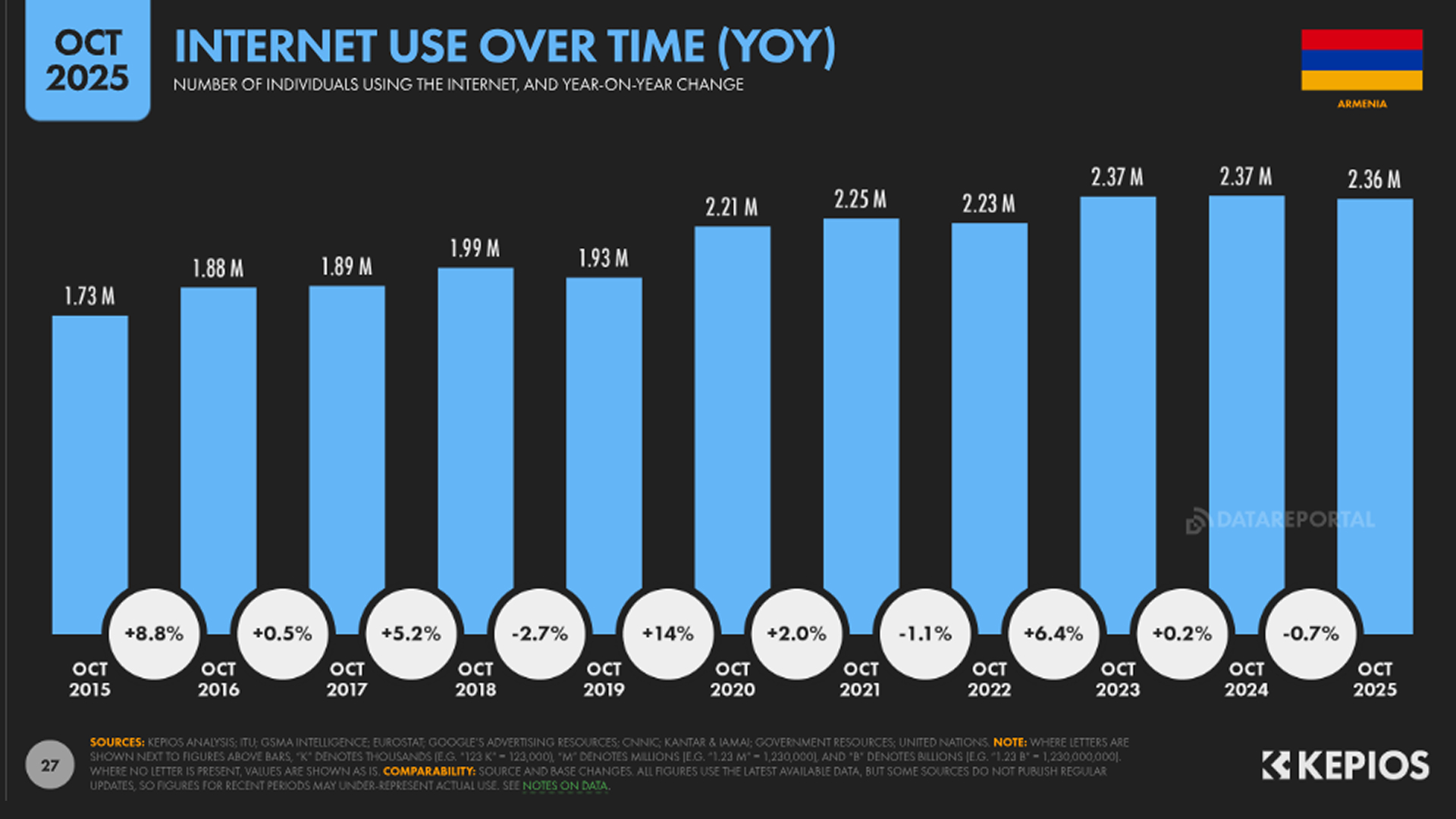
Digital marketing in Armenia is one of the key communication tools between brands and audiences. According to DataReportal, by the end of 2025 Armenia had 2.36 million internet users — 80% of the country’s population.
Such a level of digital engagement strengthens the role of online tools in marketing. Mobile formats are gaining particular importance, as a significant share of interactions now occurs via smartphones.
In this article, we review the key trends of Armenia’s digital market, analyze shifts in consumer behavior, and highlight the growing role of mobile campaigns.
We also share expert perspectives on the future of digital from the teams at BYYD, AMCG Agency, Tsiran, Supermarket Chains 88, Publicis Hepta Armenia, and EasyPay.
How Digital Marketing in Armenia Is Changing
Internet Audience Dynamics: A Digitally Mature Market
Armenia’s digital ecosystem is no longer an emerging niche. The internet has become a basic infrastructure of everyday life.
According to statistics, by October 2025 the number of internet users in the country reached 2.36 million. For comparison, in October 2024 it was 2.37 million. In practice, the audience remains stable. A fluctuation of less than 1% indicates not a market decline but the achievement of natural penetration limits.
This signals a transition to market maturity. Previously, growth was driven by onboarding new users; today, the depth of digital service usage matters more. Users spend more time online, interact more actively with apps, and make purchases more frequently in digital environments.
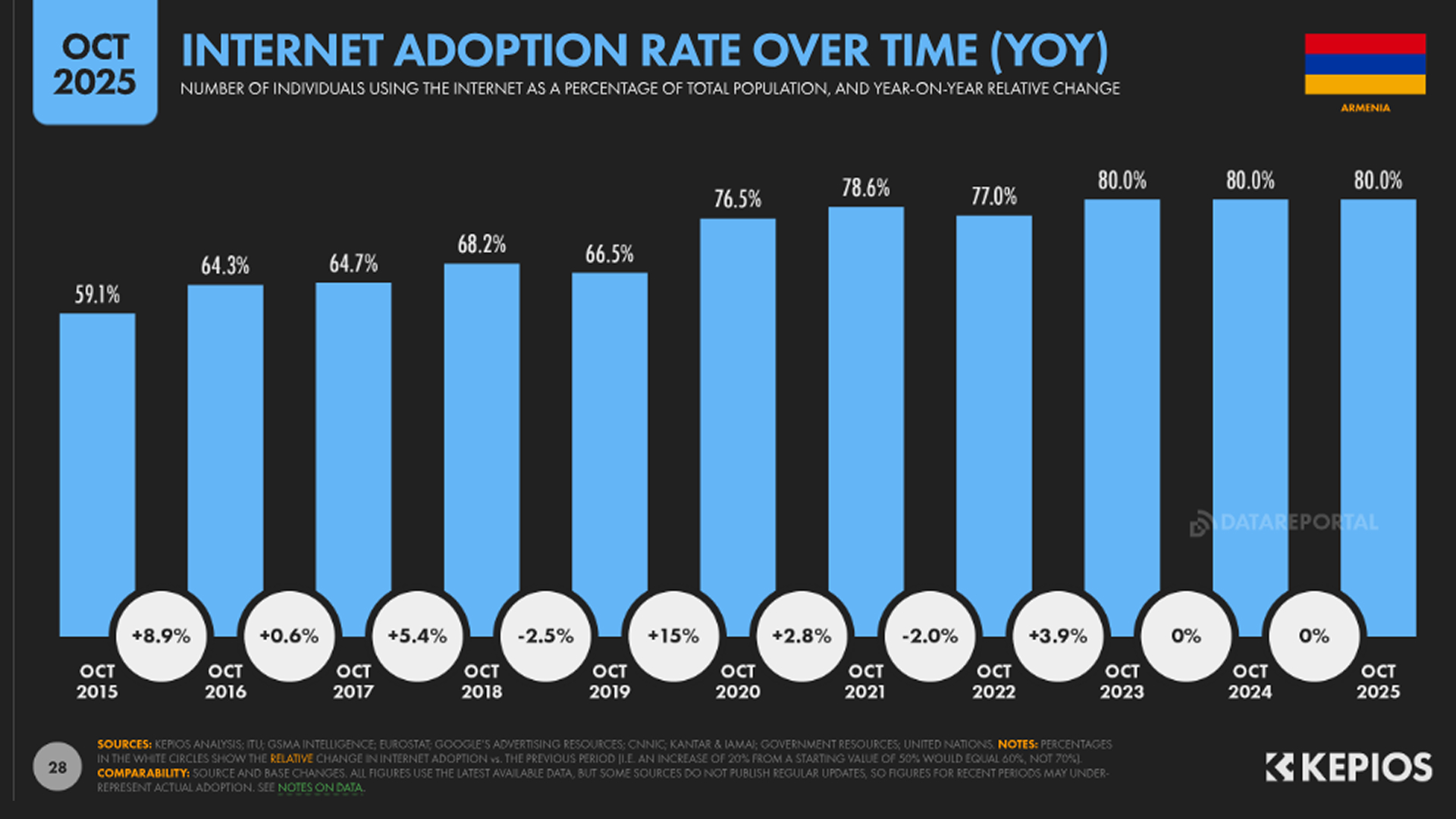
In both 2024 and 2025, internet penetration consistently stood at 80% of the population. Competition is now unfolding within an already formed audience. Therefore, precise targeting and personalization are becoming decisive.
High penetration also strengthens the role of the mobile environment. The user journey — from search to purchase — increasingly takes place in apps. This creates favorable conditions for programmatic growth.

Tigran Parseghyan, Chief Marketing Officer, EasyPay:
After COVID, digital in Armenia has definitively ceased to be an “additional channel” — in 2026 it will become the foundation of marketing strategy for nearly all active businesses. The market is becoming more mature: fewer chaotic launches “for reach” and more systematic work with analytics, unit economics, and real efficiency. We will see a stronger mobile-first approach and growth of performance tools, but the key focus will be funnel quality — from creative to payment. This is especially evident in e-commerce and fintech, where users already expect a seamless journey and fast digital service.
User Behavior Is Moving Beyond the Browser
According to StatCounter, in January 2026 nearly three quarters of website visits came via desktop browsers:
- Computers — 75%
- Mobile devices — 25%
- Tablets — less than 1%
Despite the dominance of desktop sessions, the mobile share remains significant. Real user journeys often extend beyond the web browser and occur inside mobile applications.
Internet Speed in Armenia: Performance Growth and Its Impact
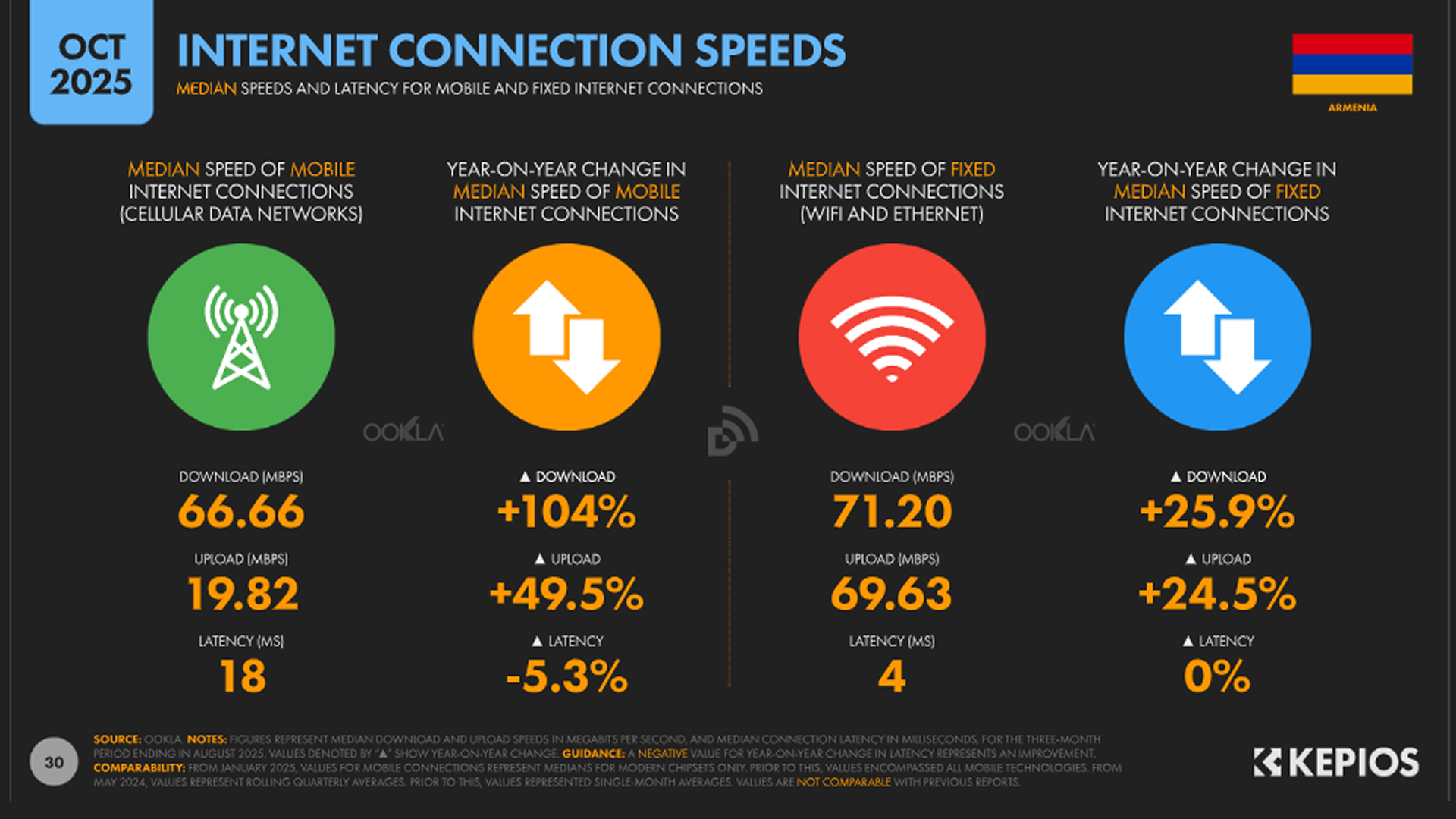
Connection speed determines how comfortably users interact with online services — from video streaming to app usage. In October 2025, Armenia demonstrated notable improvements in connectivity.
Average mobile internet speed reached 66.66 Mbps (+104% year over year), while fixed broadband reached 71.20 Mbps (+25.9%).
The growing availability of high-speed connectivity creates favorable conditions for media content. For advertising, this means brands can more actively use video formats and interactive banners such as Rich Media and Video Interaction in in-app environments without compromising user experience.
Social Media Becomes the Primary Communication Channel
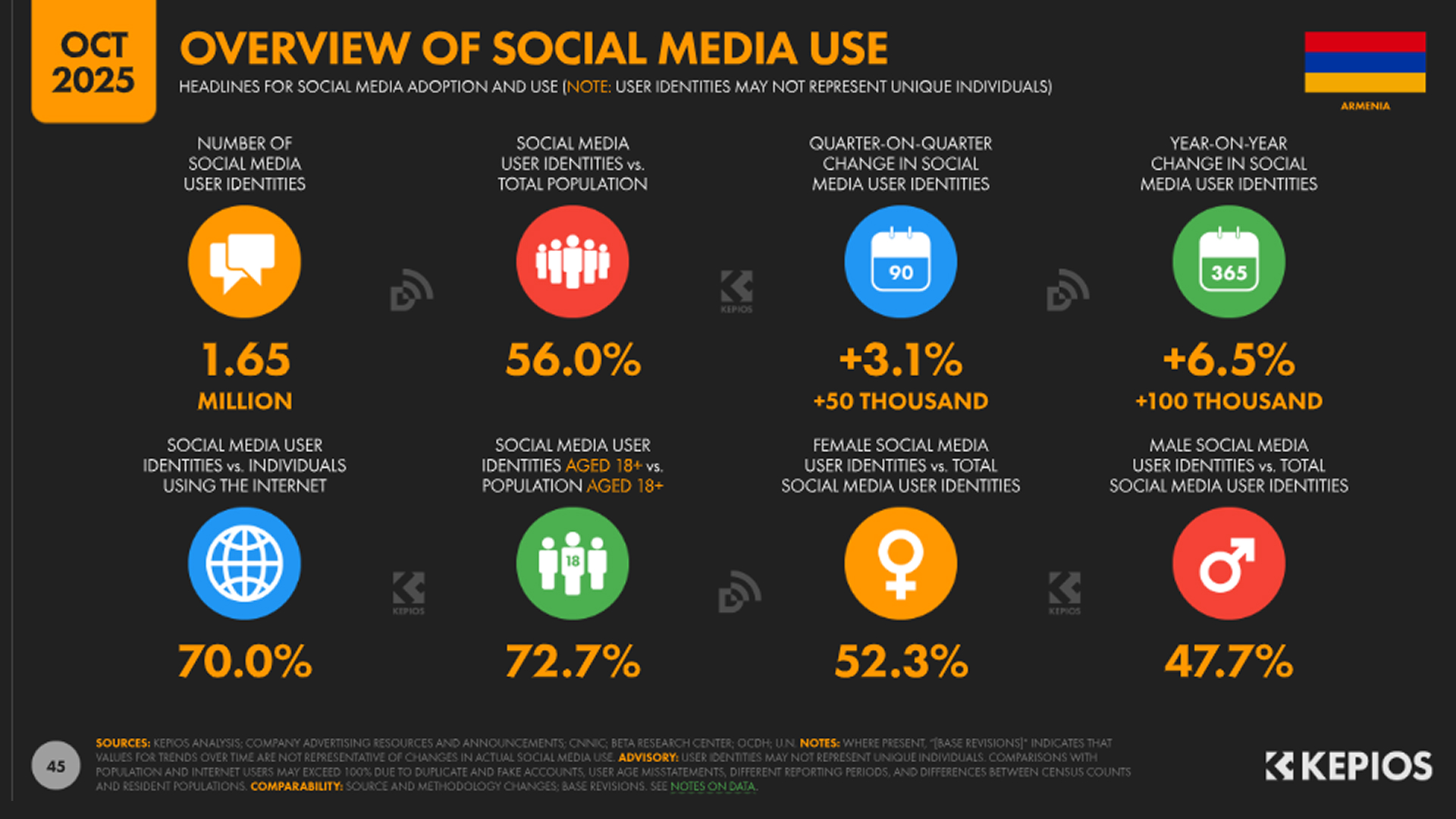
Armenia counts 1.65 million social media users — 56% of the population. Among adults, penetration reaches 72.7%.
Social platforms have become a stable channel for brand-consumer interaction, significantly influencing the country’s digital marketing landscape.

Artak Harutyunyan, Founder of SMARTOLOGY Academy and AMCG Agency:
In my view, Armenia’s digital market in 2026 is moving along the “mobile + AI + performance” trajectory. As of early 2026, monthly active social media audiences total around 1.6 million unique users (expert estimate), keeping businesses highly dependent on social platforms and short-video formats. Full-funnel strategies are no longer viable without a substantial share of social traffic. At the same time, new players like TikTok and YouTube Shorts are still primarily seen as reach tools. Therefore, in 2026 we can expect intensified CRM retargeting and lookalike audience strategies, leading to stricter first-party data management. In other words, the market is splitting into two segments: reach and performance.
Marketplaces Accelerate E-commerce in Armenia
In 2025, Wildberries significantly strengthened its impact on Armenia’s e-commerce market. The number of Armenian sellers on the platform grew by 106%, while sales volume increased by 122%.
One of the main growth drivers was the expansion of Armenian brands into export markets. In 2025, exports from Armenia via the platform increased by 184%, while sales of Armenian-made goods grew by 22%.
The strongest export growth was recorded in Russia (+20%), Belarus (+18%), and other countries (+53%). Leading categories included beauty, cookware, and home appliances.

Vergine Simonyan, Head of Digital Department in Publicis Hepta Armenia
Local e-commerce infrastructure continues to grow but often relies on integrations via social channels and chat-based orders rather than fully developed digital marketplaces.

Artak Harutyunyan, Founder of SMARTOLOGY Academy and AMCG Agency:
Expectations for 2025 were confirmed. What was forecast as “mobile-first and e-commerce acceleration” has effectively materialized. Armenia’s e-commerce market continues to grow and evolve. More than 80% of content and over 90% of advertising traffic comes from mobile devices (internal observations). Alongside the expansion of native mobile payments (Apple Pay, Google Wallet), e-commerce is developing further. AI tools and vibe coding have also lowered the barrier to launching sales platforms — and this market is still at an early stage of development.
AI as a Tool, Not a Replacement for Human Content
AI is becoming a foundational tool for content creation worldwide. According to Social Media Examiner, 90% of marketers already use AI for text tasks, while 60% use it daily. Adobe reports that 86% of global creators have integrated generative AI into their workflows.
This trend is also visible in Armenia.

Lilit Voskanyan, Marketing Director, Supermarket Chains 88 and Tsiran:
In 2025, brands increasingly used AI to generate videos and human-like visuals. This helps accelerate production and reduce content costs. However, audiences may gradually grow tired of overly “artificial” visuals, even online. Therefore, the value of authentic content will rise: real employees, real customers, natural speech — less gloss, more trust. The best approach for 2026 is AI as a production tool, with human emotion and brand authenticity at the center.
Digital Marketing in Armenia: BYYD Expert View

Monika Shahverdyan, Country Manager BYYD (Armenia, Georgia, Egypt, Japan):
With internet penetration at 80%, future growth will come not from new users but from improving efficiency within the existing audience. This increases the importance of data-driven approaches and automated media buying. User journeys are shifting toward mobile applications, raising the value of in-app placements for brands. At the same time, e-commerce is accelerating, increasing demand for tools that deliver high-quality traffic. In 2026, the key success factors in Armenia’s marketing landscape will be precise targeting, cross-channel analytics, and mobile programmatic campaigns.
Artak Harutyunyan, Founder of SMARTOLOGY Academy and AMCG Agency:
Among the key characteristics of 2026, I would highlight three:
— E-commerce in Armenia is no longer an “additional channel”; it has become the core driver, with focus on conversion and repeat purchases. A vivid example is the Yerevan City app.
— Mobile advertising is strengthening through in-app and vertical video formats. Even industry presentations are increasingly designed vertically for mobile viewing.
— The creator economy is becoming more professional: the shift from one-off influencer integrations to long-term creator partnerships with clear performance metrics, structured UGC pipelines, and attribution discipline. In simple terms, marketers now expect leads from influencers — not just “nice” posts.
Lilit Voskanyan, Marketing Director, Supermarket Chains 88 and Tsiran:
In 2026, digital marketing in Armenia will likely grow not through entirely new channels but through smarter execution in familiar ones: social media, performance, CRM, and retention. Brands will focus more on efficiency metrics — not just reach, but cost of acquisition, repeat rate, and which content truly drives purchases. Simply “being in digital” is no longer enough. Winners will be those who rapidly test hypotheses, personalize communication, and combine creativity with analytics — especially in retail and FMCG, where purchase decisions are made quickly.
Vergine Simonyan, Head of Digital Department in Publicis Hepta Armenia:
In 2026, Armenia’s digital marketing market is evolving in line with global trends but with local specifics. With internet penetration around 80% and mobile connections exceeding 130% of the population, the market remains strongly mobile-first. Social media reaches more than half the population, while messengers and digital services are used not only for communication but also for direct brand interaction. Throughout 2025, automation and data analytics played an increasing role in marketing optimization. Personalization and AI approaches are gradually being embedded into strategies. However, the development of some advanced targeting tools and sophisticated advertising features still lags behind larger markets, limiting precision capabilities. Key vectors for 2026 include deeper automation, advanced data analytics, stronger personalization, and cross-channel strategies aligned with Armenian audience behavior.
Tigran Parseghyan, Chief Marketing Officer, EasyPay:
In 2025, AI truly became part of everyday marketing operations — from creative generation to customer journey automation. While I have always supported hands-on creative production, this year we already see major players returning to craft. In 2026, simply “using AI” will not be enough. Brands must be correctly represented in the digital environment. This introduces a new focus — GEO (Generative Engine Optimization). Today, it’s not only about being found by people, but also about being correctly interpreted and cited by AI systems. If a company does not structure its expertise, build transparent digital presence, and generate authoritative mentions, it will simply not appear in generative answers. Therefore, 2026 is about maturity. About trust. About data. And about strategic thinking. Armenia’s digital market is growing — but winners will be those who think one step ahead, considering not just the click but the brand’s position within the broader digital ecosystem.
Programmatic Advertising in Armenia
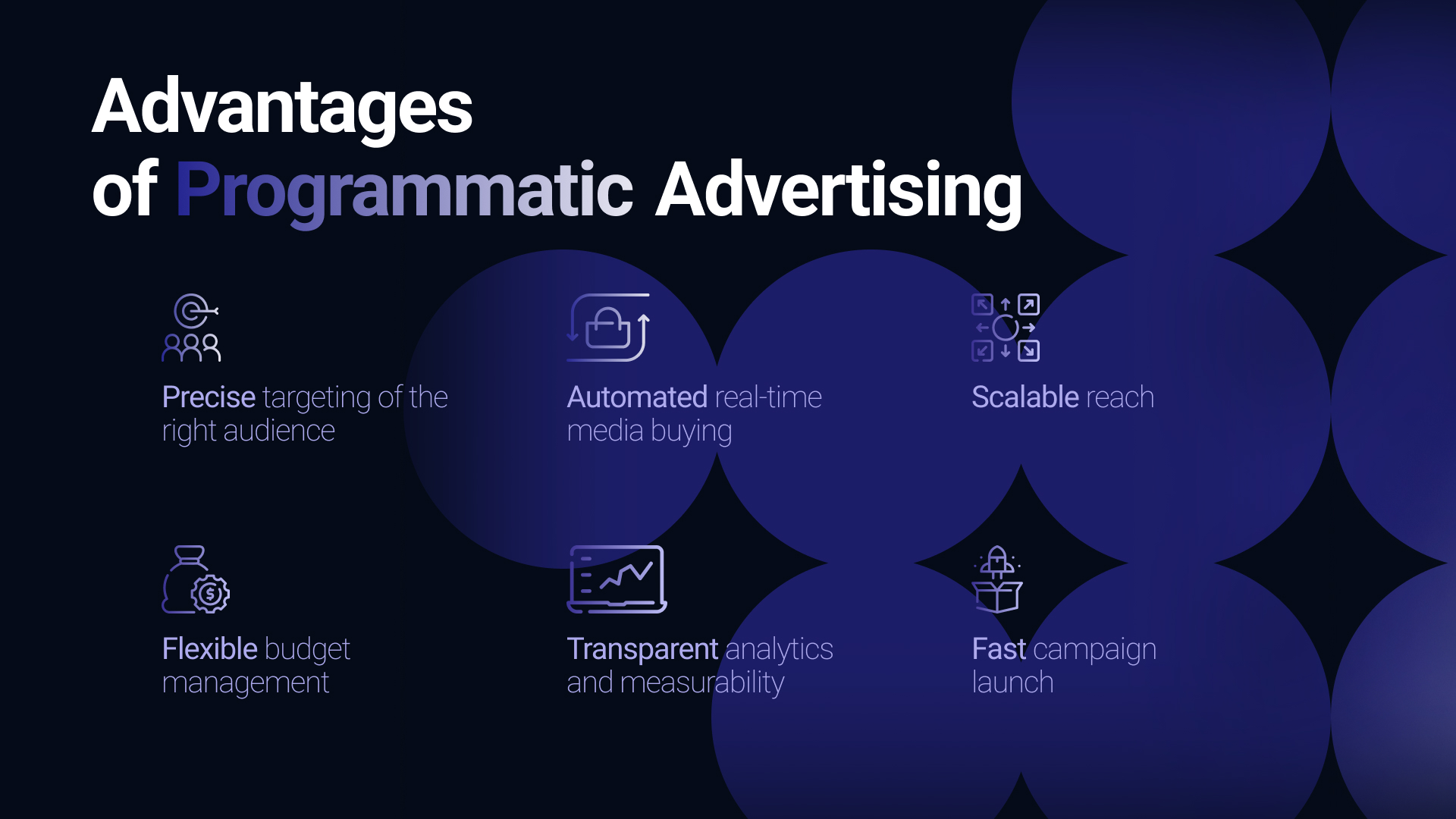
Brands are competing for the attention of an already formed internet audience. This increases demand for data-driven tools. As a result, programmatic — the automated buying and selling of digital advertising in real time using algorithms and user data — is gaining popularity.
At the same time, user journeys from content consumption to purchases increasingly occur in apps. This trend drives demand for programmatic advertising in mobile apps and games.
To learn more about mobile advertising or to launch an in-app campaign:
- Submit a request on our website
- Email us at hello@byyd.me